Sunday, November 15, 2015

Belrock Mansion


The Bell Mansion, or Belrock Mansion as it became known, is in Sudbury, Ontario.  The largest city in Northern Ontario, Sudbury was founded in 1883 when Tom Flanagan, a Canadian Pacific Railway blacksmith, discovered nickel ore.  Flanagan noticed a rust-coloured patch of rock in an area where the railway crew had just blasted.

In 1896, William and Katherine Bell arrived in Sudbury from Pembroke, Ontario.  William Bell was born on July 29th 1858, in Pembroke.  His wife, Katherine, was the daughter of Senator James Skead and was born in Ottawa.  William, a lumberjack, was originally employed by the Hale and Booth Lumber Company, but soon moved to the Spanish River Lumber Company, where he became a manager.  By 1924, William had gained control of the Spanish River Lumber Company, and he remained president until 1932, when the company was sold.  

An entrepreneur, William's interests were not limited to the lumber industry, and he became president of Cochrane - Dunlop Hardware Company and the National Grocer Ltd.  He established mining operations along Lake Wanapitei, and named the community that housed the operations Skead, in honour of his wife and her family. 

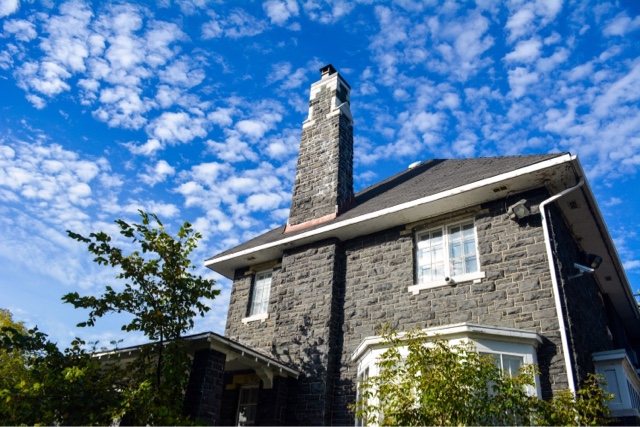
Having become a prosperous couple, the Bells built the Bell Mansion in 1907 on 155 acres adjacent to Lake Ramsey.  Constructed from local stone, the mansion was 6000 square feet.  There was a detached servants' quarters that was reportedly linked to the main house by a tunnel.  There was also a greenhouse gazebo, stables and a coach house.  The gardens were crafted by a gardener that was employed throughout the entire residency of the Bells.  The architect of the building is unknown, but there has been conjecture that it was a Scottish architect. 

Bell died in 1945 and bequeathed 110 acres of the estate to Sudbury.  When Katherine died, childless, at the age of 90 in 1954, she left the Mansion and most of its contents to Memorial Hospital, which used the building as a staff residence.  On December 3rd 1955, the Bell Mansion was gutted by fire, with only the outer shell remaining.  It was rebuilt and purchased by The Nickel Lodge Masons.  Zoning issues resulted in the building being boarded up for nearly a decade.  In 1966, it was purchased by the Centennial Committee of the Chamber of Commerce.  It was then officially transferred to Laurentian University in 1968, which went on to lease the space to the Sudbury Art Gallery. 

There have been many reports of paranormal activity at the Bell Mansion.  There have been orbs photographed around the building.  A witness reportedly saw a woman in Edwardian dress walking along a corridor and through a door into Gallery 3.  Footsteps and crying children have been heard in the building when it was supposedly empty.  It's also said that, if you stand in the building and sing, Katherine will sing along with you.

I loved this building.  It is built from unique materials, and has a beautiful facade. 


Sunday, November 8, 2015

Stonehenge

Located 90 miles west of London and 8 miles north of Salisbury, Stonehenge is a prehistoric monument in Wiltshire.  Built by a culture that left no written record of its construction, there are Mesolithic potholes dating back 8000 years.  Believed to have been built in 3500BC, the construction of Stonehenge occurred in three phases over around 1500 years.  Its name comes from the Saxons and means Hanging Stones.

Stonehenge was constructed out of two distinct stone types: bluestones, representing foreign stones of which there are about twenty at Stonehenge, and Sarsen, sandstone rocks found on the Salisbury Plain.

Originally, Stonehenge was a circular bank and ditch that contained what became known as Aubrey Holes.  These holes were identified by John Aubrey, an antiquarian, natural philosopher and pioneer archaeologist, in the 17th Century.  In this initial stage of construction, it is believed that the first of the standing stones were erected to stand on slightly sloping grassland.

Two hundred or more years later, the second phase of construction at Stonehenge commenced.  During this time, bluestones were transported from Wales.  They were erected and then taken down again sometime during this period.  The giant stones that dominate the site now were put in place.  Some of these stones weigh 26 tons and stand 18ft high with a width of 7ft.  The trilithons, which are three stones fitted together, were erected.  The stones were wrought to make them slightly convex and then slotted into place with lintels.  Finally, they were hinged together using ball and socket joints.

About 1500 years after construction began on Stonehenge, the bluestones were re-erected in the circle and a large green sandstone block, known as the Altar Stone, was placed in front of one of the trilithons.

There has been much conjecture over the purpose of Stonehenge.  Medieval authors, including the bard Geoffrey of Monmouth, referred to the monument as the "Giants Dance", and believed it was constructed by Aurelius Ambrosius, King of the Britons.  It was said that he wanted to build a memorial where 460 British consuls and princes lay buried after being massacred.  Aurelius Ambrosius sought the counsel of the wizard Merlin, who advised him to get the Giants Dance from an Irish mountain called Kilarus.  Aurelius sent his brother, Uther Pendragon, and an army.  They got the monument, and it was believed that Merlin transported the massive structure. 

In the 17th century, Inigo Jones, an English architect, suggested that Stonehenge was most likely a Roman Temple.  By the 18th century, antiquarian, cleric and Freemason, William Stukeley, concluded it was a Temple of British Druids. 

The stones of Stonehenge are lithophones, meaning they are ringing rocks.  These were believed to have healing properties.  Stonehenge may have been a place of healing.  There have been suggestions that Stonehenge may have been like Lourdes, something further supported by the high number of burials and trauma deformities in the area.  It's also been suggested that it may have been an ancient calendar to track the movement of the sun and moon and the changing seasons. 

In 2013, a team of archaeologists excavated 50,000 cremated bones from 63 individuals buried at Stonehenge.  The bodies belonged to men, women and children equally.  Cremation burials were also found in the Aubrey Holes.  Stonehenge, at one time, was used to hold funerary rights. 

Stonehenge has many myths and legends surrounding it.  In recent years, two tourists have accidentally filmed 'anomalies' that look like spirits around the mystical stones. 


There have been sightings of unexplained lights above Stonehenge, as well as light anomalies between the stones. 

When I visited Stonehenge, I could understand why these standing stones have evoked so much conjecture and mystery.  The standing stones are cordoned off and, as a tourist, you walk around the outside of the structure.  There is definitely a feeling that something ancient and mystical exists at Stonehenge. 


Sunday, November 1, 2015

Glastonbury Tor

Known by the Britons as Ynys yr Afalon or The Isle of Avalon, Glastonbury Tor is a hill in Somerset, England.  Rising to an elevation of 158m (518ft), the Tor is formed from clay and blue lias dating back to Jurassic times.  A conical-shaped hill, Glastonbury Tor has seven almost symmetrical terraces.  It's believed that the terraces may have been the result of natural forces, although theories as diverse as agricultural development or a hidden labyrinth have been put forward as possible explanations for the symmetrical anomaly.

The Tor attracted civilization as early as prehistoric times, as evidenced by the discovery of flint tools at the summit of the hill.  From the Dark Ages onwards there were at least four structures built on Glastonbury Tor.  An early church and hermitage were thought to have been built during Saxon and medieval times.  A wheel cross, a Bronze Age Celtic wheel design with four spokes representing the chariot of the sun, was recovered from the Tor. 

The first church built on the Tor was destroyed in 1275 by a strong earthquake.  In the fourteenth century, a second church was built and dedicated to St Michael by Abbot Adam of Sodbury.  St Michael's Church survived until the Dissolution of the Monasteries in 1539.  This was an act perpetrated by Henry VIII, during which he dissolved Catholic Churches and acquired all their land and income.  St Michael's Church was demolished except for the tower.  During these times the Abbot of Glastonbury, Richard Whiting, and two of his monks, John Thorne and Roger James, were hung, drawn and quartered on the Tor.

In 1786, Richard Colt Hoare of Stourhead bought the Tor.  Hoare, an antiquarian, traveller and archaeologist, funded repairs on the Tower including the rebuilding of the north-east corner.  The Tor passed on through several generations to the Reverend George Neville.  In the twentieth century, the Tor became a memorial to a former Dean of Wells, Thomas Jex-Blake, who died in 1915.  In 1933, Glastonbury Tor was taken over by the National Trust. 

The Tor has long been associated with things of a mystical nature.  It's believed to be the Avalon where King Arthur came to heal; his and Guinevere's bodies are rumoured to have been found at the nearby Glastonbury Abbey by monks in the 12th century.  Adding to the notion of it having been an island is a strange phenomenon that occurs at the Tor, called Fata Morgana.  This Italian term is associated with Morgana Le Fay, a powerful sorceress from Arthurian times.   The Fata Morgana is a visual effect that occurs because of the damp low ground around the Tor, making it appear to rise from a sea of mist. 

The Tor has also been associated with the First Lord of the Other World and, later, the King of the Fairies, Gwynap Nudd.  The Leader of the Wild Hunt, Gwynap Nudd was a great warrior.  It was said that the Tor was a doorway to the underworld and, on still nights, Gwynap Nudd's hounds can be heard.  It is believed that St Collen, who created a hermitage upon the Tor, used Holy Water to make Gwynap Nudd disappear. 

The Tor has been the scene of unusual light phenomena.  There are reports of a female ghost with glowing gold hair that some believe is Guinevere.  Many myths, legends and mysteries, from giant zodiacs to hidden labyrinths and converging ley lines, surround the Tor.  I had wanted to see the Tor since reading about it in a book.  Approaching Glastonbury, the Tor was visible from quite a long way away, dominating the surrounding landscape.  Climbing the Tor was quite an experience, and the view from the top was breathtaking.  There is no doubt that it is a place of magic and otherworldly things. 


Sunday, October 25, 2015

Santa Monica Pier

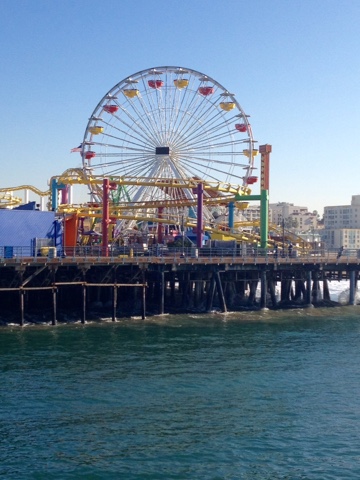
The current Santa Monica Pier consists of two adjoining piers.  The first pier is a 1600-foot-long Municipal Pier that was opened in 1909 to carry sewer pipes beyond the breakers.  In order to combat the weather and sea conditions, the pier was the first one on the west coast to be constructed of concrete.  In 1916, Charles I. D. Looff and his son, Arthur, constructed a short wide adjoining pier to the Municipal Pier.  Looff was a Danish-born American master carver and builder of carousels.  During his life he built 40 carousels, rollercoasters, Ferris wheels and several amusements parks.  The Pleasure Pier, built in Santa Monica by Looff and his son, included the Looff Hippodrome building which, by 1922, would house the beautifully carved 40-horse carousel, a wooden rollercoaster, the Whip, merry-go-round, a Wurlitzer Organ and a Funhouse.  The Looff carousel was so popular he added another row of horses.

In 1919, the concrete piles unexpectedly collapsed.  This resulted in a two-year process of replacing the concrete piles with creole-treated wooden piles.  Eventually, the concrete deck was also replaced by treated wooden deck boards.

After years of thriving, the popularity of the pier waned during the depression years.  Following the death of his father, in 1924, Arthur Looff sold the Pleasure Pier to the Santa Monica Amusement Company.  They decided to build the biggest ballroom in the world.  They hired T.H. Eslick to design the building with a Spanish facade and a French Renaissance interior.  The La Monica Ballroom opened on July 23rd, 1924.  More than 50,000 people attended the opening.  Equipped with a 15,000-square-foot hard maple floor, the Ballroom served many purposes in its time, including a venue for a radio show, a car exhibition and even a rollerskating rink.  Sadly, the La Monica Ballroom was demolished in 1963.

During the 1930s, the pier was primarily used as a ferry dock.  In 1938, the pier gate and bridge were constructed.  The amusement park facilities were closed down and some of the attractions were sold.  In 1943, Walter Newcomb, a Venice banker, purchased the pier from the Santa Monica Amusement Company and changed its name to Newcomb Pier.  He revitalised the amusement park and replaced the ageing Looff carousel with a 1922 Philadelphia Toboggan Carousel.  Following Walter's death in 1948, his wife, Enid, took over the management of the pier for the next 26 years. 

In the 1950s, George and Eugene Gordon purchased the pier.  The pier started to fall into disrepair and, in the 1960s, many of the buildings - including the Hippodrome - were used as apartments.  These apartments attracted all manner of bohemians, artist, actors and hippies.  In 1975, the apartments were destroyed by fire.  Becoming more and more of an eyesore, the city acquired the pier and various plans were discussed to remove the pier.  In response to these proposals, the citizens of Santa Monica created a group called "Save Santa Monica Pier".  It was decided that the pier should be preserved. 

In January 1983, a huge storm hit Santa Monica, destroying the lower deck of the pier.  In March, when the repairs had just started, another storm hit.  This second storm dragged a crane that was repairing the pier into the sea.  As it was dragged into the sea, the crane battered at the pier.  A third of the pier was destroyed. 

In 1987, work was started to rejuvenate the pier.  Concrete pilings and a concrete fishing deck were added.  Santa Monica Pier now has restaurants, bars, shops, entertainment arcades and an amusement park. 

The Santa Monica Pier is said to be haunted by a tall shadowy figure.  This figure has been seen walking across the roofs of various of the pier buildings, as well as riding on the carousel.  As far back as the 1960s, people living in the apartments in buildings on the pier reportedly heard the carousel organ playing in the middle of the night, despite no-one having access to the carousel. 

The Santa Monica Pier is a popular fishing spot and, over the years, several fishermen have disappeared from the pier, leaving fishing buckets and rods behind.  Some believe that they were mugged or swept out to sea.  Many people have reported hearing the sound of dull footsteps, spinning reels and rattling fishing buckets at the end of the pier when no-one has been on site.

I have been to Santa Monica Pier many times, and always enjoy my visits to this beautiful place on the sea.


Sunday, October 18, 2015

Falkland Palace

Situated at the foot of the Lomond Hills of Fife, Falkland Palace was originally used as a hunting lodge. Prior to the construction of the palace, a hunting lodge existed on the site in the 12th Century. By the 13th Century the lodge had been expanded and became a castle owned by the Earl of Fife. A great wood of oaks existed between the royal stables and the River Eden. Parklands, groves, meadows and orchards surrounded the castle. In 1371 the castle was destroyed by an invading English army.

The Duke of Albany, Robert Stewart, the younger son of Richard II, chose to make the castle his home.  He was appointed the Guardian of Scotland by his father in preference to his elder brother John.  Despite this, John became King Richard III. As he suffered ailing health his younger brother Robert maintained a tight control over the kingdom.

In 1402, the twenty four year old son of Robert III, David Stewart, was imprisoned by his uncle in Falkland Palace. He was probably starved to death. James, the youngest son of Robert III, fled Scotland, only to be captured by English pirates, some believe after receiving a tip off from his uncle.
Robert, Duke of Albany retained power until his death in 1420.  In 1424 James returned from captivity and after executing Murdoch, the 2nd Duke of Albany, Robert Stewart's son, he took over Falkland Palace. 

The palace became a country retreat for the Stewarts.  Falconry was practiced and deer were hunted.   A large pond was used for fishing.  Wild boars were imported from France and let free to roam in the fenced royal gardens. 

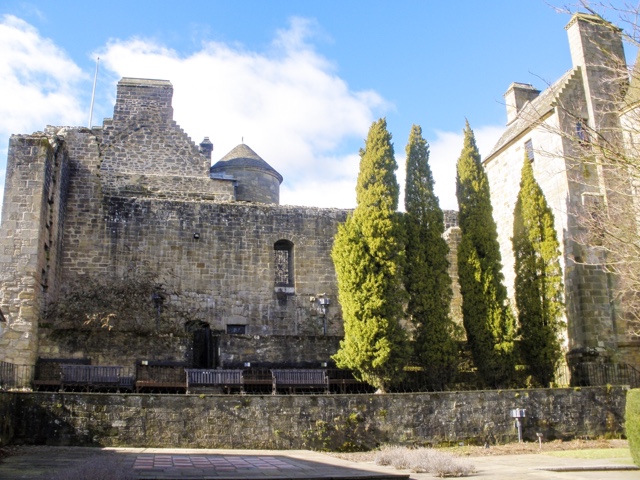
Between 1501 and 1541 Kings James IV and James V transformed the old castle into a beautiful palace. The south range of the Palace was built and the buildings were extended in French Renaissance style. James V built a Royal Tennis Court, now the oldest tennis court in the world. James V died from apparent shock caused by the loss by his army at Solway Moss and his wife producing a female heir, Mary, later to be known as Queen of Scots. Queen Mary loved Falkland Palace and it is documented that she caused a commotion when she played tennis on the Royal Tennis Court in men's breeches. 

An accidental fire in 1654, caused by Oliver Cromwell's troops, destroyed much of Falkland Palace. 

In 1887 John Crichton-Stuart, 3rd Marquess of Bute, purchased Falkland Palace. He rebuilt much of the palace, completing work on the Gatehouse, the South Range and the Cross House, before his death in 1900 at the age of 53. Work continued on the palace and the gardens were enhanced.  The addition of a Victorian Greenhouse to the grounds meant that exotic plants and flowers could be grown. In 1903, celebrated garden designer, Percy Cane worked on the gardens.  

In 1952 the Hereditary Keeper Major Michael Crichton-Stuart appointed the National Trust for Scotland as keepers of Falkland Palace. 

The beautiful Tapestry Gallery in Falkland Palace displays the famed verdure tapestries, or garden tapestries, most commonly depicting garden foliage and most likely created in France.  It is in this gallery that the ghost of a woman is said to wander. The woman is described by witnesses as having a grey glow about her.  She is said to stand by the window of the gallery weeping.  It's believed that she is waiting for her lover who went to battle and never returned. 

When I visited Falkland Palace I was struck by its beauty but also the fact that the ill-fated Mary Queen of Scots had enjoyed the Palace and the sports its gardens had offered. She was said to have been happy there.  The Palace is a beautiful piece of architecture which is surrounded by gorgeous gardens.  The oldest Royal Tennis Court in the world is also there for visitors to see.