Sunday, January 17, 2016

Calton Hill

Calton Hill is situated in central Edinburgh, and was originally referred to as Cragingalt.  The hill, valley and lowland between it and Greenside were granted to Edinburgh by James II in 1456.  The land was to be used as a place where tournaments, sports and other war-like deeds could be practised.  Becoming known as Caldtoun, the anglicised name being Cold Town, by 1725 the area was referred to as Calton and Calton Hill. 

The first substantial development on Calton Hill was the Old Calton Hill Burial Ground, located on the south-western side of the hill.  Making up three sides of Calton Hill are the elegant thoroughfare made up of Royal Terrace, Calton Terrace and Regent Terrace.  Designed by famous Scottish architect William Henry Playfair, the largest townhouse is on Royal Terrace.  Most of the properties on the terraces are houses, but there are some hotels.  Gardens on the summit of the hill are privately cared for by a Residents' Association. 

On the steep southern side of the hill is the Scottish Government based in St Andrews House, which had been built in place of the notorious Calton Hill Prison, later known as Saughton Prison.  The ornate Regent Bridge, constructed by famed author Robert Louis Stevenson's grandfather, Robert Stevenson, traverses a deep gorge connecting Calton Hill to Princes Street. 

Several famous monuments adorn Calton Hill.  Built between 1807 and 1815, a commemorative monument was constructed in honour of Vice Admiral Horatio Nelson.  1st Viscount Nelson, 1st Duke Bronte, was a renowned tactician, which resulted in him winning many naval battles.  The Calton Hill Nelson Monument was erected to specifically celebrate Nelson's victory against the French and Spanish in the Battle of Trafalgar, a battle in which Nelson lost his life.  In 1853, a time ball was added to the monument to signal time to ships in Leith Harbour. 

The Dugald Stewart Monument was built as a memorial to the Scottish philosopher, Dugald Stewart, who held the seat of Moral Philosopher until his death.  Designed by architect William Henry Playfair, the monument is modelled on the Choragic Monument Of Lysicrates in Athens.  Also designed by Playfair is the City Observatory.  Inspired by the Greek Temple of the Four Winds, it was built in 1818.  It is enclosed in a boundary wall, and the oldest part of the structure is the Gothic tower also known as Observatory House.  The first Astronomer Royal was Professor Thomas Henderson, who took the position in 1834.

Built in the Old Calton Burial Ground is the 90ft (27m) obelisk erected to commemorate five political reformists and referred to as the Political Martyr's Monument.  The 19th-Century Neoclassical building referred to as the Old Royal High School was built on Calton Hill to serve as Edinburgh's first Royal High School.  Modelled on Hephalsteion of Athens, the building was designed by architect Thomas Hamilton. 

Designed by Charles Robert Cockerell and William Henry Playfair, the National Monument is modelled on the Parthenon in Athens.  Erected in honour of Scottish soldiers and sailors who died in the Napoleonic Wars, building on the monument began in 1826.  Lack of funding resulted in the monument not being finished, the unfinished building being called many names, including Edinburgh's Folly.

In 1824, the sculptor John Flaxman was commissioned to create a lifesize statue of the poet Robert Burns.  The sculptor based his work on a painting of the poet by Alexander Nasmyth.  The poet was carved holding a bunch of daisies with a bonnet and thistle at his feet.  The monument in which the statue was placed on Calton Hill was designed by Thomas Hamilton.  The statue of Burns was removed from its monument due to it being damaged by the local gasworks.  It is not Robert Burns' only connection with Calton Hill.  On the west side of the hill is a street called Calton Hill.  A woman called Agnes Maclehose lived on the street.  Burns had an unconsummated affair with the married woman, the two of them corresponding using the pseudonyms Clarinda and Sylvander.  Between 1787 and 1788, Burns sent many verses to Agnes.  He based his famous song, "Ae Fond Kiss", written in 1791, on her. 

Rock House, situated on the southern-western entrance to the hill, was the home of Robert Adamson who, with his partner David Octavius Hill, were pioneers of the calotype photographic process in Scotland.  Many photographs were taken by them in the garden and the house on Calton Hill. 

There is much folklore surrounding Calton Hill suggesting it had played a key role in Pagan rituals.  Beltane is still celebrated on the hill.  The Beltane Fire Festival is held on the 30th of April every year. 

It is believed that Calton Hill is a gateway to the Fairy Kingdom.  There is a story surrounding a boy that lived in the port town of Leith.  It is said that, each week, he made his way to Calton Hill, and entered the hill through huge gates only visible to those with the second sight, in this case a gift bestowed on the boy by the Fairies.  He would play the drum for the fairy folk.  He became known as the Fairy Boy.

Calton Hill was also used to burn witches.  The beautiful Lady Glamis was publicly burned for witchcraft on Calton Hill. 

It's quite a trek up the side of Calton Hill, passing beautiful buildings and the graveyard.  The view at the top of the hill is magnificent.  The monuments and buildings at the summit are quite an interesting mix of architecture that seem exotic and strange on this beautiful hill in the middle of Edinburgh.


Sunday, January 10, 2016

Egeskov Castle, Denmark

Egeskov is one of the best preserved Renaissance water castles in the world.  It is situated in the south of Funen, the third largest island in Denmark.  Although there was mention of Egeskov as early as 1405, construction of the actual castle began in 1554.  In response to civil unrest caused by the Count's Feud, a conflict that took its name from the Protestant Count, Christopher of Oldenburg, and the hostilities around the Protestant Reformation, many Danish noblemen built fortified homes.

In 1554 Frands Brockenhuus, a vassal and a rigs marsk, a commander in the Danish Army, began building Egeskov on land that belonged to his wife of a year, Anne Tinhuus.  It is said that an entire forest of oak was used to create oaken piles for the water castle to be built on in the centre of a small lake.  The castle was, in fact, named Oak Forest, Egeskov.  Not only was the water surrounding the castle used to fortify the structure, but a drawbridge, artillery ports, scalding holes and arrow slits were also part of the structure's defenses. 

The castle was constructed using oversized medieval bricks called Monk's bricks.  Consisting of two long buildings connected by a thick wall, Egeskov has round arched windows and gables.  The double wall has a water well within it. 

Frands Brokenhuus spent thirty years building the castle and, when he died, his son, Laurids, inherited Egeskov.  In 1589 Laurids' daughter, Rigborg, was sent to the court of King Christian IV to serve as a Lady-In-Waiting for his wife, Anna Catrine.  Rigborg became close to a young nobleman called Frederik Rosenkrantz the following year.  She fell pregnant and gave birth to a son, Holger.  Rosenkrantz was engaged to another woman, Christence Viffert, at the time.  Laurids Brockenhuus demanded a trial, and Rosenkrantz was sentenced to exile after having two fingers on his right hand severed.  The sentence was reduced and he was sent to fight in the war against Turkey.  Rosenkrantz left for England and, apparently, became Shakespeare's inspiration for Rosenkrantz and Guilderstern, Hamlet's betrayers.  Rosenkrantz later died in a duel in Prague. 

Rigborg was sentenced to imprisonment in Egeskov.  She was locked in a room for five years and her child was sent to live with his father's family.  With the death of her father, Rigborg's mother appealed to King Christian IV to reduce her daughter's sentence.  He allowed Rigborg to leave her room once a week to see a priest.  In 1616, Rigborg's mother secured permission for her daughter to live on her own estates.  This occurred in 1625 when her mother died.  In 1626, Rigborg was reunited with her son Holger.

Egeskov passed through various families and, in 1784, it was sold to Henrik Bille, whose descendants have owned the castle ever since.  Julius Ahlefeldt-Laurvig Bille moved into the castle in 1883.  He renovated the castle with the help of Swedish architect Helgo Zettervall.  The tower roofs were heightened and a gatehouse was built.

Egeskov was developed into a farm, with its own dairy, power plant and a railway to Kraerndrup.  The castle has been open to the public for several generations and, in 1967, a Veteran Car Museum was opened in the barn.  The Car Museum went on to expand into several other farm buildings.  The Banqueting Hall was restored in 1975. 

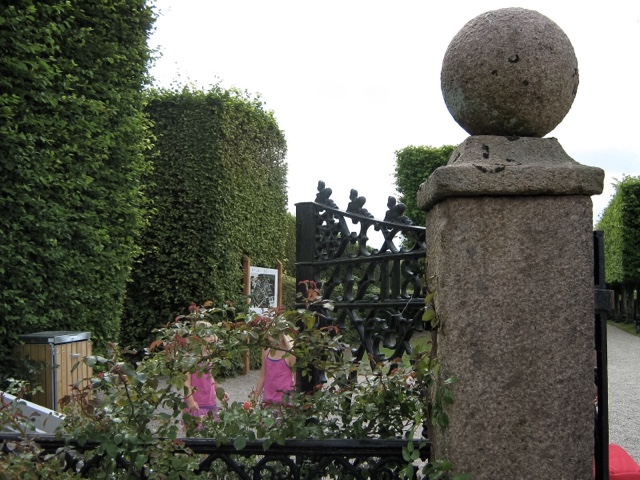
Since 1994, Michael and Caroline Ahlefeldt-Laurvig Bille have lived at Egeskov.  The castle has become one of Denmark's most popular tourist attractions.  The grounds have a renaissance garden with fountains and topiary figures.  There is an English Garden, Herb and Vegetable Garden and an elaborate Water Garden.  There are four mazes in the grounds of the castle, the oldest one being a Beech Maze.  A three-metre-tall sundial in the castle grounds was especially designed by Danish poet and mathematician Piet Hein.  There is also a wooden carving of Dracula in the gardens.  A full-sized replica of Egeskov castle was built in Hokkaido, Japan, to serve as an aquarium. 

Within the rafters of Egeskov castle, laying on a red velvet cushion, is a carved wooden doll which has been there since the castle was built.  Legend has it that, if the doll is ever moved, the entire castle will fall into the lake it's built in on Christmas Eve.  There have also been reports of strange noises coming from the parade armour that is on display.

I loved going to Egeskov.  I initially went there to see the display of the famed dollhouse, Titania's Palace.  Once I was there I was entranced by the beautiful castle and the spectacular gardens.  Toys and all sorts of treasures are on display in the castle and on the grounds, including an amazing Car Museum.  Egeskov is a magnificent place to spend some time.