Showing posts with label Niagara-on-the-Lake. Show all posts

Sunday, January 19, 2020

Fort George


Fort George is an historic military structure at Niagara-On-The-Lake, Ontario in Canada.  The fort was built by the British Army between 1796 and 1799 following the Jay Treaty.  Designed by Alexander Hamilton and supported by President George Washington the Jay Treaty was negotiated by American statesman and Diplomat, John Jay.  Brokered between the United States and Great Britain, the Jay Treaty was created to avoid war and resolve issues that remained following the Treaty of Paris in 1783 which ended the American Revolutionary War.  As part of the Jay Treaty the British Troops withdrew from Fort Niagara which stands opposite in New York and is visible from the Fort George ramparts.  The newly constructed Fort George became the western most of British fortified posts and served as the regional headquarters for both the British Army and the Canadian Militia.  

Fort George was built using earthworks and palisades or stakewalls, a wall made of wooden or iron stakes.  The fort internal structures including an Officer’s quarters and a stone powder magazine where ammunition and other explosives could be stored.  Also within the fort a blockhouse was constructed to house the ranks and also accomodate their families.  

During the War of 1812 to 1815, a conflict between the United States and the British Army plus their respective allies, several battles were fought in the area of Fort George.  In 1813, just after dawn on May 27th clearing fog revealed an American vessel off the shore.  Military Commander, Scott Winfield was tasked with leading the first landing party for the American assault.  Starting west of the mouth of the Niagara River Scott landed on the British territory while American Naval Commander Oliver Hazard Perry and his men directed a schooner to silence nearby squadrons that were supporting Fort George.  The American landing parties were charged by bayonet wielding men from the Glengarry Light Infantry as they waded ashore.  The Glengarry men were outnumbered and after loosing half their men retreated.  The schooners in Lake Niagara, using grapeshot, a non-solid projectile made up of an arrangement of round shot  packed into a canvas bag, attacked a company of The Royal Newfoundland resulting in them sustaining heavy casualties.  

After landing, Military Commander Scott advanced up the beach only to meet with British Troops.  Between Scott’s landing party and further fire from Commander Perry’s schooner the British Army sustained heavy losses.  The commanding officer of the Niagara Peninsula in Upper Canada, General John Vincent, realised that his troops were out-numbered and ordered an immediate retreat to Queenston.  Before their retreat General Vincent ordered the Fort guns of Fort George to be spiked and the magazines blown up.  Despite this Commander Scott was able to secure Fort George with little damage.  After inflicting heavy casualties on the British Army the Americans were able to secure several heavily fortified positions, including Fort George.  

The Americans remained in a small military enclave around and within Fort George.  In June 1813 an American column marched from Fort George to attempt to surprise a British outpost at Beaver Dams.  The American troops stopped in the town of Queenston overnight.  A resident of Queenston, Laura Secord walked 32kms (20 miles) through American occupied territory to warn the British Troops that the Americans were coming.  When the Americans resumed their march they were ambushed by Native warriors and surrendered.  About 500 Americans including their commander were taken prisoner.  The Americans abandoned Fort George following this defeat as it was on the British side of the river.  Fort George was then left to fall into ruin.  In the 1930s the site was reconstructed.  

During the First and Second World War Fort George was used as a military training base under the name of Camp Niagara.  In 1966 the military left the fort.   Fort George was then staffed by costumed characters and maintained by Parks Canada as a living museum with re-enactments.  It has hosted such events as the 1955 World Scout Jamboree.  

Fort George is considered one of the most haunted places in Niagara.  One commonly sighted apparition is refered to as the “Woman in the Mirror”.  She is a young curly haired woman that haunts the officer’s quarters and is dressed in a white dress.  Two men dressed in red uniforms are also seen in the officers quarters.  On occasion soldiers dressed in white are seen laying in the bunks in the officers quarters.  Staff have also reported an apparition in an area of the fort closed to the public.  The ghost is fondly referred to as Irving and he haunts the upper level of the barracks.  

One area of the fort that is considered extremely haunted was only actually built in the 1960s.  A tunnel built of stone and wood stretches seventy feet from inside the walls of the fort to the blockhouse.  Despite it being built well after the battles Fort George endured, both during the day and night, the tunnel been the scene of paranormal phenomena both visual and auditory.  

One of the most well known ghosts in Fort George is a seven year old girl known as Sarah Ann. She is believed to have been the daughter of one of the soldiers and to have died of a disease. The apparition has been seen and heard by staff and visitors to the fort.  The apparition of Sarah Ann has been known to tap people on the shoulder.  

Like all haunting there is much controversy about the phenomena at Fort George.  While staying in Niagara-On-The-Lake I would often walk to the fort. Fort George has a somber feel especially in the snow.




Monday, April 24, 2017

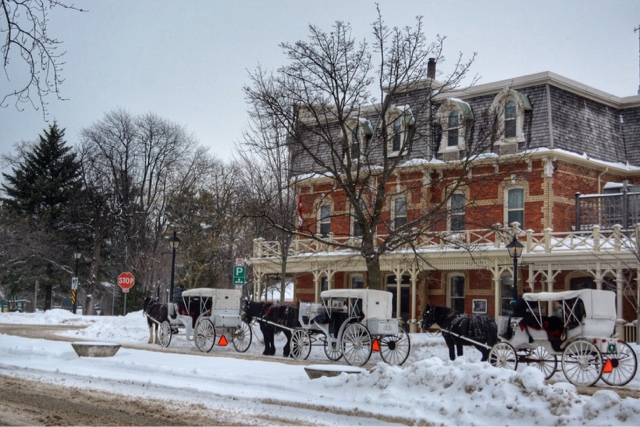
The Prince of Wales Niagara-On-The-Lake

Located on King Street and Picton in the historical precinct of Niagara-on-the-Lake, The Prince of Wales hotel was built in 1864 by William Long.  Niagara-on-the-Lake, once known as Newark was the first capital of Upper Canada and the bustling shipping town had served as the First Seat of Parliament and headquarters of the British Army during the War of 1812.  The 1864 cornerstone of the hotel, still visible today, shows that the building was constructed three years before the Confederacy, the uniting of the British Colonies of Canada, Novia Scotia had New Brunswick to create one Dominion of Canada.  

William Long called his hotel Long's Hotel and it originally catered to all manner of guests.  Long was a hotelier as well as an auctioneer.  He often used the hotel dinner bell to advertise sales during his auctions. The hotel was completely rebuilt in 1888.  Built in red polychrome bricks the building is designed in the Second French Empire style.  Adhering to this architectural style the Prince of Wales has a unique mansard roof, beveled corners and quoins.  In 1890 Long was involved in an accident involving runaway horses.  His recovery was drawn out and the ensuing stress meant the hotel was eventually sold in 1899 to Patrick J. O'Neil.  The hotel was renamed Niagara House.  

The hotel was marketed by O'Neil as an "Uptown Summer Hotel" that was catering to the well-to-do travellers coming to Niagara-on-the-Lake from the United States and Europe.  Among the guests that came to stay at the hotel were the Prince of Wales King George V, son of Queen Victoria, and his wife Mary.  In honour of the visit the hotel name was later changed to The Prince of Wales.  Following O'Neil's death the hotel was sold to the Brownlee family. The hotel lost popularity during the depression.  In 1975 the Weins family purchased the hotel.  They refurbished the hotel, extending it along Picton and King Street.  John Wein added a South Wing, the Court Building and the Studio.  

In 1997 the Prince of Wales was added to the Vintage Hotel properties owned by Jimmy Lai.  The hotel was closed in 1998 for extensive refurbishments. Lai placed his sister, Ms. Si Wai Lai in charge of the renovations.  She went on to hire design architect Victor Tarnay to assist.  On July 1st 1999 the Prince of Wales reopened.  The renovations captured the essence of the hotel's history.  A large stained glass wall, created by Gundar Robe, decorates the foyer.  Ms. Lai also payed homage to her Chinese heritage acquiring an ivory table, dating back to the K'ang-his dynasty of 1662-1722, engraved with a battle scene, that once belonged to the Empress Dowager Tzu Hsi. The Prince of Wales has the largest collection of Victorian style rooms in Canada.  

There are many conflicting accounts of the hauntings in this building.  One account suggests that a wooden house on the land prior to the hotel was the home of a young woman.  During the siege of Niagara-on-the-Lake in the War of 1812, an American soldier was asked to search the supposedly abandoned building.  After searching the first floor and finding it clear the soldier had proceeded upstairs to the second floor.  He saw a figure by the window, rushed towards it and ran his bayonet through what he thought was a British soldier.  He actually murdered Molly McGuire, an innocent woman, who had been looking out at the lake hoping her husband was returning.  The room that sits in the location of the place in which Molly McGuire was murdered is room 207 in the Prince of Wales. Lights have been known to flicker in this room and water faucets turn off and on by themselves.  

Another source confusingly cites the origins of the ghost, whose spectral form has been seen wandering in the foyer, along the halls and in room 207 as actually being a woman from the early 1900s.  The woman supposedly fell in love with a soldier training at Camp Niagara during World War One.  With the soldiers departure date approaching the young couple decided to have the ceremony and honeymoon at the Prince of Wales.  Following the ceremony the soldier was sent to France.  For a year they wrote letters of love and longing before the woman received a cable explaining that her husband had been killed.  The woman refused to believe it was true and locals in Niagara-on-the-Lake got used to seeing the forlorn bride standing at the window of her room in the Prince of Wales looking out at the street.  She became so distraught and convinced her husband had deserted her that she never left the room.  The woman was found deceased in the room clutching a picture of her husband.  In relation to this haunting there have been flickering lights, the sighting of a wispy spectral figure, rapping on doors and an ethereal face staring from the window of room 207 when no one is in the room.  

One of the problems with the paranormal not being taken seriously is the fact that many of the supposed "experts" or "investigators" writing about these reported events do no research and dates are wrong.  Ghosts and hauntings are described with all sorts of errors in the events.  These pieces of information are then shared and a game of Chinese whispers ensues resulting in erroneous details being shared and hence giving skeptics fuel.  

I have been to Niagara-on-the-Lake many times and always stay at the beautiful Prince of Wales.  I enjoy the High Tea served in the Drawing Room and the beautiful suites decorated authentically.  If this lovely hotel is haunted it doesn't ever feel like something bad. I have had a little experience here myself while lounging in one of the beautiful baths in the corner suite.  My radio turned on unassisted.  I just enjoyed the bath and the ethereally chosen music.