Showing posts with label spooky. Show all posts

Monday, August 10, 2020

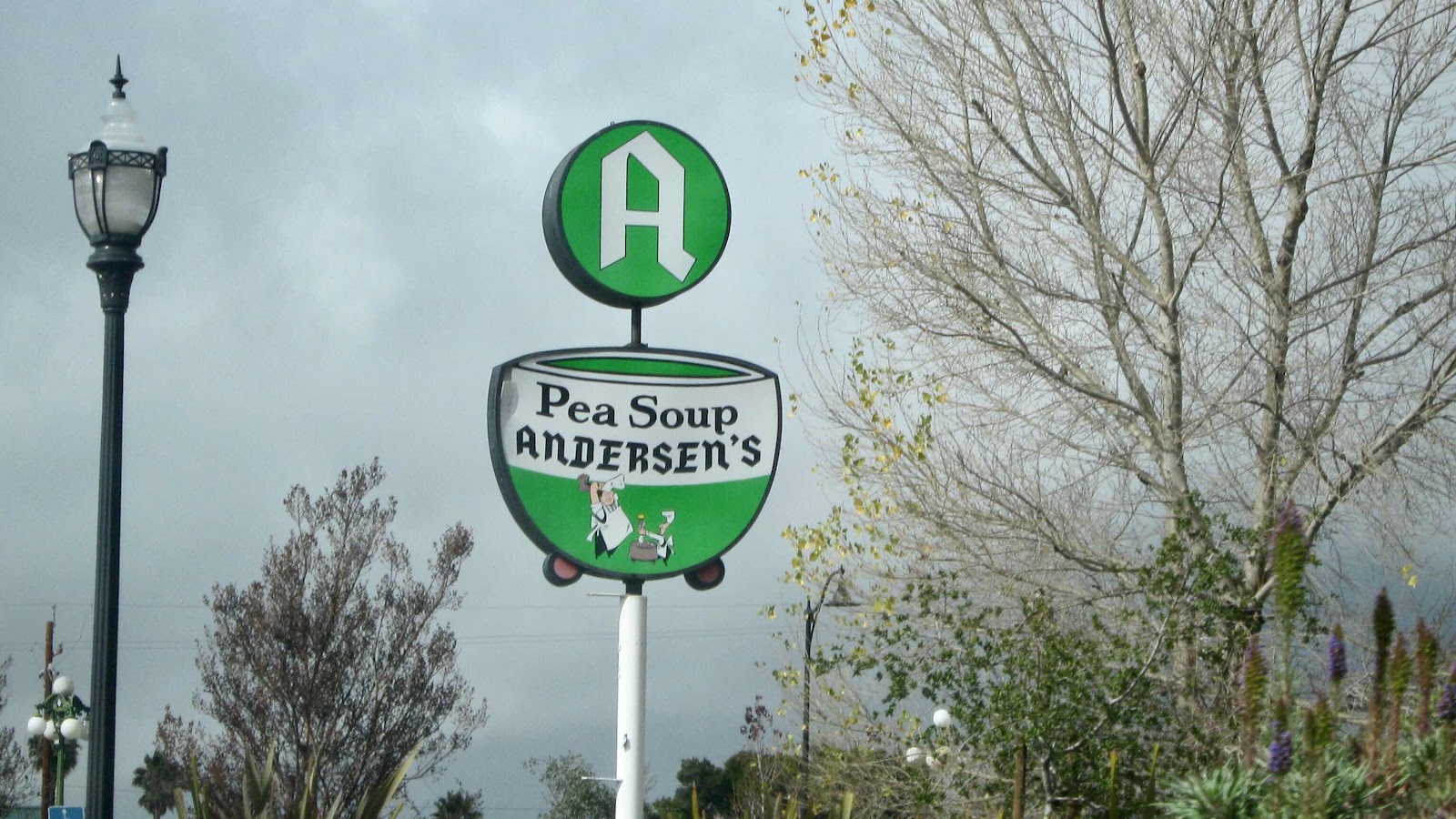
Pea Soup Andersen’s

Pea Soup Andersen's is a restaurant chain in California.  It was founded in 1924 by Anton Andersen and his wife Juliette.  Born in Denmark, Anton Andersen had trained as a chef in Europe and New York, also helping with the opening of the Biltmore Hotel.  He and his wife purchased a property in the small town of Buellton, California in Santa Barbara County, neighbouring Solvang, a Danish community of recent immigrants.  

The land in Buellton had previously been part of a Mexican Land Grant owned by Jose Maria Corarrubias and Joaquin Carillo of Santa Barbara.  The land was purchased by the Buell Brothers in 1865.  R.T Buell turned the land into a prosperous horse and cattle ranch and a dairy farm called Ranch San Carlos de Jonata.  Buell married Miss Emily Budd in 1892 and they had five children.  When Buell died in 1905 he was buried in the family plot which would later become the car park for Pea Soup Andersen's.  His body was later moved to Oak Hill Cemetery in Ballard.

The area of Buellton, located in the Santa Ynez Valley, changed rapidly and by 1911 Danish immigrants, attracted to the area, were settling there opening businesses and farms.  When the highway was diverted through Buellton and electricity was bought to the valley the Andersen's saw an opportunity.  They opened a small restaurant called Andersen's Electrical Cafe.  The name was in honour of their prized new electric stove.   

With a menu of simple foods including hotcakes, ice-creams, sodas and coffee, the café was created cater to the people that travelled the highway.  Initially the customers were mostly people that were travelling between Los Angeles and San Francisco.  The café also happened to be on the road to Hearst Castle at San Simeon. This was the heyday of the Hearst Media empire and writers and journalists such as Arthur Brisbane, one of the best known newspaper editors of the 20th Century and O.O McIntyre, a newspaper columnist of the 20s and 30s, stopped to eat at Andersen's. In this way praise for the establishment and the food it served was sent all across the country.

What would become the famous pea soup, a family recipe belonging to Juliette, Anton Andersen's French wife, was first added to the restaurant's menu three months after it was opened. Juliette was a fabulous cook and was responsible for preparing many of the popular recipes on the menu. As the establishment became more popular in 1928 the Andersen's built a hotel and dining room as well as sinking a well.  the Andersen's called the new establishment The Bueltmore, a play on the name of the Biltmore Hotel.  As Anton had worked in many well known restaurants, many famous chefs stopped by the Bueltmore.

In the 1930s Robert, Anton and Juliette's son, returned from Stanford University.  Robert became instrumental in the marketing aspect of the restaurant.   He discovered a cartoonist called Forbell who created a cartoon entitled "Little Known Occupations" for a magazine called Judge.  The illustration depicted two chefs creating split pea soup using a chisel to split the peas.  Andersen obtained the rights to the image.  Robert famously used billboards as part of his marketing strategy.

Robert Andersen married Rosemary Mohan who opened a gift shop attached to the restaurant.  the couple had a son called Robert in 1942.

During WWII the restaurant was closed to the public and  instead served as a place that military personnel and their family were served meals.  When the war was over Pea Soup Andersen's reopened.  Robert commissioned a Disney trained artist to draw the two mascots for the restaurant Hap-Pea and Pea-Wee, whose names were chosen through a competition.

In 1947 the new coast road was rerouted through the centre of Buellton.  That year the name of the restaurant became Pea Soup Andersen's. In 1965 Vince Evans, a successful business man and leader in the Santa Ynez Valley, purchased the restaurant.  He was said to have bought Pea Soup Andersen's on a whim because he enjoyed the soup. He promoted the restaurant like it was a Hollywood film putting huge billboards up and hiring new chefs.   Thriving under Evans management, the restaurant was said to be producing three quarters of a million bowls of soup a year.  Evans added a small wild animal park and aviary filled with parrots as well as a miniature train to further attract customers.  By the 1970s this was all demolished to make way for a Danish themed hotel.  In 1967 a second location was established in Santa Nella, California in Merced County.  The property had a restaurant, hotel, gas station and a gift shop as well as a working windmill.

Two short-lived restaurants were opened in Carlsbad and Mammoth Lakes.  Following the death of the Evans family in 1980 the restaurants passed through several owners.  Buellton and Santa Nella are now owned by Milt Guggia, a central coast restauranteur.

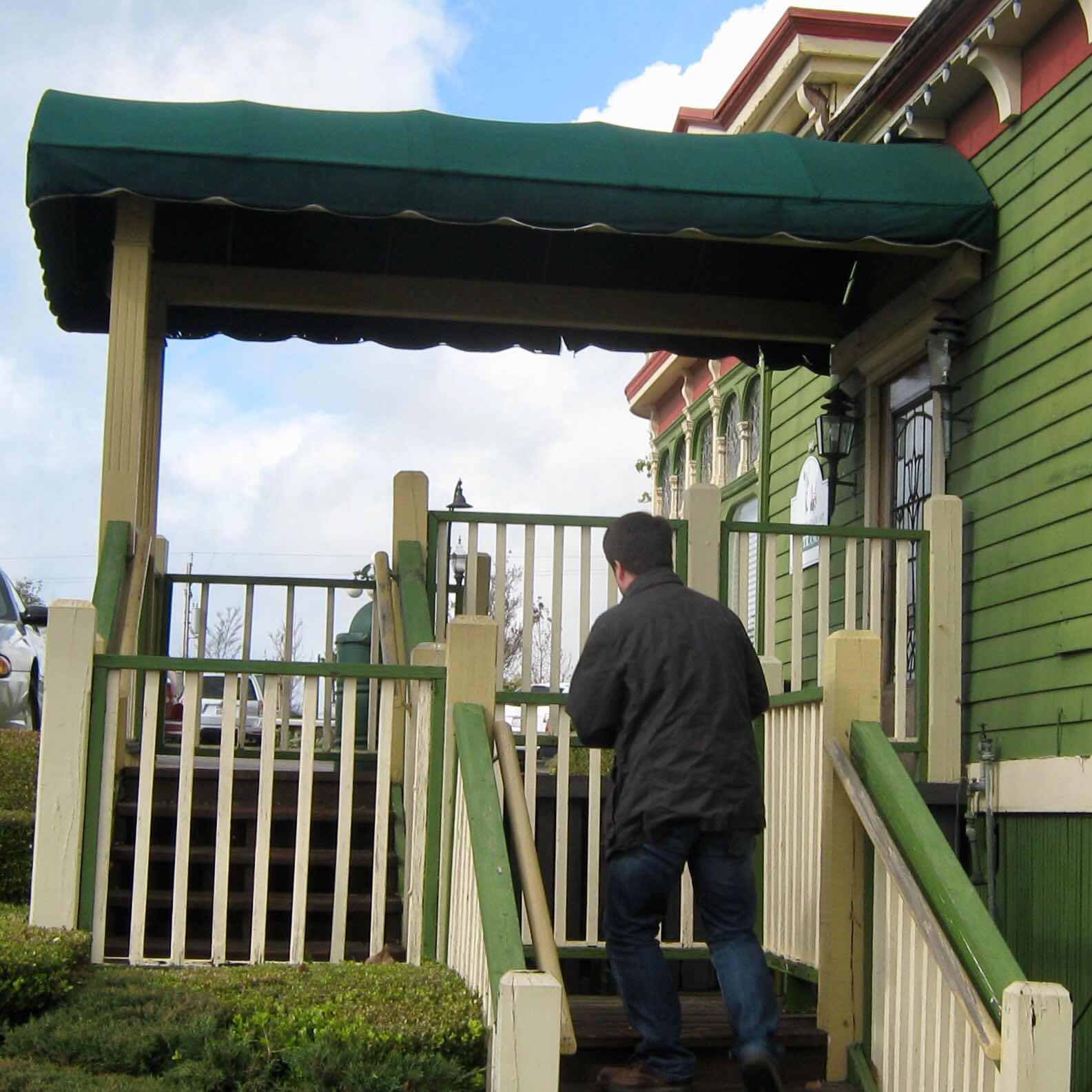
The Buellton Pea Soup Andersen's is said to be haunted by former owner Juliette Andersen.  Strange sounds, unexplained music and doors opening and closing have all been reported.  Furniture is also said to move on its own accord.

I have been to Pea Soup Andersen's several times on various trips to California and I always find it charming.  The soup is very delicious and the gift shop always has unique and interesting wares. 


Tuesday, May 16, 2017

Flynn House

During the nineteenth century the Irish were the largest group of immigrants to arrive in Canada.  The Great Famine of 1845-1851 and in particular Black 47, the worst year of the potato famine in Ireland, saw 38560 Irish refugees arrive in Toronto. At the time the population of Toronto was only 20000.  Although many of the Irish refugees travelled on to America some stayed and became an instrumental source of labour during the economic boom in the 1850s and 60s in Toronto.  

Daniel Flynn, a master shoemaker, and his wife Sidney moved to Canada from Ireland during the Potato Famine. Flynn worked as an itinerant shoemaker and cobbler for almost a decade.  It was common for a shoemaker, or cobbler, who primarily repaired shoes, to visit a home and mend or make new shoes for a family.  

After a decade Flynn purchased two lots of land in what is now North York, Toronto, formerly known as Newtonbrook, from a Joseph Beckett.  The two lots of land were located on what is now Yonge Street and Drury Road in Toronto.  Flynn built a house with a boots and shoe shop attached in 1858.  The Flynn family, now consisting of Flynn, his wife Sidney and their two daughters designed the house in Ontario Classic Style.  The building consisted of four downstairs rooms, all with wooden floors, two bedrooms and a combined living room and kitchen.  The front room was initially used by Flynn as his workshop.  Eventually as his business grew Flynn constructed a seperate boots and shoe store on the land beside the house, the vacated workshop in the house becoming the kitchen.

The Flynn house was relocated to the Black Creek Pioneer Village in 1959. It is a unique building in the village as it directly reflects how a tradesman lived in the nineteenth century in Ontario.  Daniel Flynn's boot and shoe shop was also relocated to the village.  

The Flynn house is said to be haunted by Sidney, Daniel Flynn's wife. She has been seen in the garden of the house in a long yellow dress.  A security guard saw the apparition of Mrs Flynn at 4am one morning  and reached out to touch her believing her to be an intruding in the Pioneer Village and she vanished.  He was so shaken by the experience he quit his job.  Mrs Flynn, in her yellow dress, was also seen by a group of guests at the village. She was said to be walking down the street and then simply vanished. The reconstructed Flynn house has paintings of saints on the walls, as was typical of Irish families of the time.  The pictures of the saints are said to move and sometimes be swapped according to staff at the Pioneer Village. Staff at the village would sometimes cook on the stove in the Flynn house.  One day a kettle was heard boiling and whistling in the house but when staff arrived the kettle and stove were cold.  Cookies and cakes baked in the Flynn house by the staff would be moved or taken. Mrs Flynn sometimes is said to bolt the door when men try to enter the house.  It's not uncommon for staff to find the bed on the right side of the parlour looking as though someone has slept in it. 

Although I didn't get to see inside the Flynn House when I visited the Pioneer Village as it was having work done, I did see it from the outside.  I did see the Flynn Boots and Shoe Store.  It is a wonderful representation of life in the ninteenth century for a couple who had come from a distant shore and made Canada their home. 


Tuesday, May 2, 2017

Burwick House

Burwick House was originally built on Pine Street in Burwick which later became Woodbridge in 1844. The house was built by Rowland Burr, who was born in Philadelphia but moved to Canada with his family when he was still a young boy.  Burr was a contractor, Justice of the Peace and landowner.  He is best known for his staunch views against alcohol and his support of building a canal linking Toronto and Georgian Bay via the Humber and Holland Rivers and Lake Simcoe and the Severn and Nottawasaga Rivers.  

Burr bought land on the Humber River, subdividing it and creating the village of Burwick.  It was here that Burr constructed Burwick House.  The house was built with an imposing facade indicative of the rural Georgian style of architecture.  Traditional Georgian architecture was a set of styles current between 1714 and 1830 based on the classical architecture of  Rome and Greece.  The style was revived in the colonies and Burwick House is a good example of the style.  

Burwick House is two storeys and was constructed with mortise and tenon joint framing and covered in clapboard.  Mortise and tenon joinery has been used for thousands of years by woodworkers all around the world to join wood mainly at an angle of 90'.  The interior of the house was finished with lath, compromising of thin strips of wood forming a foundation for the plaster.  Burwick House has a kitchen at the rear and was constructed with an adjoining coach house.  In 1958 Burwick House was one of the first structure relocated to the Black Creek Pioneer Village, a recreation of 19th Century life in rural Canada on Black Creek, a tributary of the Humber River.  The front part of the building was moved first.  The kitchen wing was faithfully reconstructed as authentically as possible.  The barn was acquired and recreated separately.  

Burwick House is a very active building with many seperate accounts of paranormal phenomena being reported by visitors to the Black Creek Pioneer Village and by the staff.  Knocking sounds, cold spots, unexplained footsteps and objects moving of their own volition have all been reported.  A grandfather clock that is situated in the house is believed to be enchanted and chimes unexpectedly even though the clock no longer works.  A staff member responsible for closing the curtains on the top storey of the house often reported coming out of the building and locking it for the night only to find one or all the curtain open again when she reached the street and looked up.  A rocking horse in the house rocks by itself like someone is riding on it.  A full female spirit has been seen standing at the fireplace or by the rocking horse.  

The Black Creek Pioneer Village is a beautiful place to visit and is filled with relocated historical buildings that seem to have bought their former occupants with them. 


Friday, June 8, 2012

Spooky Places and Megalophobia

There is a place in the East of Australia that doesn't feel right. Warranted, the first time I drove across it was on a stressful occasion, on a rainy night. The fact the place felt ominous I merely put down to the ambience and my state of mind that night. A year later I again traversed this natural basin in the landscape, this time in bright sunshine. It is an expanse of land void of trees or shrubbery but covered in short grasslike foliage. There are a smattering of properties scattered across its foreboding length. These homesteads are only obvious because of barbed wired fences and the occasional gate, with a tall house behind them set back from the road, jutting from the flat landscape. The first homestead you pass as you enter the plain is called Hells Gate and it gets worse from there.

I suffer from a weird phobia that has haunted me my entire life. It's called Megalophobia. Basically it's a fear of large and looming objects. Mine seems to be specific to huge ships in the water looming above me and large spouts of water or high fountains. Even as a baby I apparently screamed if a ship was shadowing above me in any way, even in a picture a book, such an image would make me cry. I recall a Disney book with people jumping to the safety of the water, from a burning ship, and being terrified of the image. I remember an incident as a small child of sitting playing in the shallow water, my back to the sea, and unbeknownst to me a catamaran gliding silently into the shore behind me. I was frozen with fear. Even the scene in the recent movie Cowboys and Aliens, with the overturned paddle steamer in the desert, made my palms sweet and my heart rate increase.

What has the plain and my weird fear got in common. On about my third trip across this foreboding piece of land, sitting low in my seat because the landscape makes me so uncomfortable. I jokingly said to my travel companions
"You know what would make this place really freak me out?"
Knowing of my fear they laughed when I explained that a huge ship traversing the flat landscape outside the window of the car would terrify me. Just as we laughed and I turned to look to my left...three huge ships, placed inexplicably in a landlocked paddock, amidst that flat and barren landscape appeared.
I could barely breathe and I was overcome by dizzying nausea.
Perhaps some farmer had bought these three ships and transported them to this place with some grand design in mind but instead ended up leaving them to rot in the fields just beyond his house. I could see no rational explanation at all and nothing about their presence there helped calm my fears about this spooky plain.

Some random images of abandoned ships..... 0.0