Sunday, February 5, 2017

Westminster

The Palace of Westminster, located on the North Bank of the River Thames in central London, is the meeting place for the two Houses of Parliament.  Although officially the palace is owned by the monarch it is effectively managed and inhabitants by the House of Commons and the House of Lords. 

As early as the Middle Ages the site of the current Palace of Westminster was deemed strategically important, mostly because of its location on the River Thames.  Its is believed that the area, known then as Thorney Island, was used as a royal residence by Canute the Great during his reign from 1016 to 1035.  The King of Denmark and Norway, Canute the Great ruled England for nineteen years.  He was fundamental in protecting England from Viking raiders, many of which he was believed to have commanded, so England was able to prosper.  

At the same time that Westminster Abbey was constructed St Edward the Confessor, among the last Anglo Saxon Kings of England,  was said to have built a palace on Thorney Island. His reign lasted from 1042 to 1066.  None of the building constructed as part of St Edward the Confessors' palace remain.  The oldest surviving parts of Westminster Palace, in particular Westminster Hall, are from the reign of King William II. The Hall was built in 1097 and was completed in two years.  It was the largest Hall in England and was so large smaller halls were required for normal use.  Westminster Palace served as the principal residence for Monarchs throughout the late medieval era.  

An early form of parliament started to meet in Westminster Palace in 1265.  The Curia Regis or the Royal Court, headed by Simon de Montforts, consisted of representatives from all the larger towns of England.  This Parliament, held by the rebel baron, Simon de Montfort, who had seized power over England from Henry III only lasted three months.  In an attempt to gather supporters de Montforts had decided to not only invite barons and knights to discussions but also burgesses, a freeman.  Although de Montfort was killed at the Battle of Evesham, the idea of inviting burgesses to parliament became popular under the reign of Henry's son Edward I.  

In 1512, a fire destroyed the principal residence of the monarch at Westminster Palace.  In 1534 Henry VIII aquired York Palace from Thomas Wolsey and renamed it Palace of Whitehall, using it as his primary residence.  Despite remaining an official palace, Westminister Oalace was only used by the two Houses of Parliament as well as The Royal Courts of Justice.  As the Palace had no purpose built rooms, important ceremonies where held on what was known as the Painted Chamber, which had been King Henry III's bedchamber.  A modest medieval hall known as the Queen's Chamber served as the meeting place for the House of Lords.  Without a specified meeting place the House of Commons often had meetings in the Chapter House of Westminister Abbey.  Eventually the Palace in St Stephens Chapel became a regular meeting place for The House of Commons.  

A new facade for the palace was designed and built by John Vardy in the Palladian architectural style between 1755 and 1770. This construction, known as the Stone Building, was primarily constructed to provide committee rooms and space for document storage. In 1795 a new residence for the Speaker of The House of Commons was built near St Stephen's Chapel.  Between 1799 and 1801 the architect James Wyatt created a much derided neo-Gothic building called The Cotton Mill.  Sir John Sloane, a British architect and a leader in the revival of Greek Revival Architecture.  He demolished the medieval House of Lords Chamber.  The Chamber had famously been the target of the failed Gunpowder Plot of 1605.  The plot was a failed assassination attempt against King James I by provincial English Catholics led by Richard Catesby.  The plot was revealed and famously Guy Fawkes was caught guarding 36 barrels of gunpowder.  In place of the demolished chamber Sloane created a new Royal Gallery.

Over the next three centuries many renovations would take place.  In the late 17th century, architect Christopher Wren undertook a major project completely redesigning the buildings.  In 1834 a huge fire, started by an overheating stove,  ravaged Westminster Palace.  It destroyed most of the rebuilt Houses of Parliament.  The only medieval structures to survive the fire were Westminister Hall, the Cloisters of St Stephen.  The Chapel of St Mary Undercroft, a crypt below St Stephens Chapel, used primarily as a wine cellar, dining room and a stable for Oliver Cromwell's horse survived even though St Stephen's Chapel did not. The fourteenth century Jewel Tower built between 1365 and 1366 as a personal treasury for the personal treasures of Edward III, also survived the fire. 

King William IV initially offered Buckingham Palace, a residence he didn't like very much, to parliament to use.  However Buckingham Palace was considered not suitable for the Houses of Parliament.  Leaving it to each House, the King left Parliament to create their own committee to best decide what they required.  In July 1835 a Royal Commission was appointed and by June 1835 it was decided that the new building would be built in Gothic or Elizabethan style.  A competition was proposed.  In February 1836, after considering 97 proposals, architect Charles Barry's Gothic style palace design won. Barry's design was Gothic Revival, specifically honouring the Perpendicular Gothic style, which emphasises perpendicular lines, of the 14th and 15th century. The interior was greatly influenced by Augustus Pugin, an authority on Gothic architectural style, in the gothic interior, stained glass, ironwork, furniture and wall paper.  The foundation stone was laid in 1840 with both Chambers completed by 1852 although some works still continued on into the 1870s.  Construction lasted for over thirty years due to rising costs and the death of two leading architects.   

During WWII the Palace of Westminster was bombed on fourteen occasions.  The worst hit was in May 1941 with the palace taking twelve hits resulting in three deaths.  The Clocktower, Elizabeth Tower, known as Big Ben took a hit and all the glass on the south dial was blown out but the bell and hands were undamaged.  The. Lock continued to keep time. 

Westminster Palace has been a Grade 1 listed building since 1970 and part of UNESCO World Heritage sites since 1987. In 2022 the building will be vacated for six years for new renovations. 

Guy Fawkes, caught during the failed Gunpowder Plot was hung, drawn and quartered for his part in the plot. His ghost has been seen wearing a traditional hat and cape wandering towards the place that would take him to the secret stash of explosives he was found guarding.  His ghost is then said to just vanish.  

There are at least two documented cases of doppelgänger in the palace.  A famous case occurred in 1905 when Major Sir Frederick Carne Rasch MP was seen in the Chambers when in fact he was at home in bed with the flu. Another suspected doppelgänger is a Mrs Millman,who worked as a clerk at the palace but was not at the palace on the occasions she was sighted there.  


Sunday, January 29, 2017

Hampton Court Palace

In 1236, The Knights of Hospitaller of St John Jerusalem acquired the manor of Hampton. A medieval Catholic military order, later to become the Military Order of Malta, The Knights of Hospitaller of St John Jerusalem, used the site of Hampton as a grange.  Serving as an agricultural centre the Knights stored and kept accounts at the site.  Later, in 1494, the property was leased and modernised by Sir Giles Daubeney to facilitate him being closer to London.  A soldier, courier, diplomat and politician Daubeney worked for Henry VII, the monarch and his wife being frequent guests at the peaceful Hampton residence of Daubeney. 

Cardinal Wolsey aquired Hampton Court in 1514 and began renovations a year later.  Wolsey was a churchman, statesman and a cardinal of the Roman Catholic Church.  In 1509 Wolsey became King Henry VIII almoner serving as a chaplain to the king and among his tasks he was in charge of distributing money to the poor.  By 1514 Wolsey was the controlling figure in matters of the state as well as being powerful in the church. Wolsey set about transforming Hampton Court into a Grand palace that was decorated with rich and opulent furnishings and decorations.  Wolsey used the property to entertain and its exuberance inspired John Skelton, HenryVIII former tutor, to comment that "The Kings Court should have the excellence but Hampton Court hath the pre-eminence". In 1529 Henry VIII took over the works at Hampton Court. 

Following issues with the Catholic Churches denial of an annulment of his marriage to Catherine of Aragon due to her inability to produce an heir, Henry VIII turned on the Catholic Church and Wolsey fell from favour.  Wolsey was then made the Archbishop of York.  In 1530 Henry VIII and his councillors sent the first of several threatening letters to Wolsey from Hampton Court.  Wolsey was summoned to return from York and died enroute. 

In 1537, following a marriage to Anne Boleyn and her subsequent execution, Henry VIIIs third wife, Jane Seymour gave birth at Hampton Court. The baby, Prince Edward, was baptised in the chapel at Hampton Court but died soon after of complications. Following the difficult birth Jane Seymour died of an infection.  Henry VIII married Anne of Cleves but then decided he wanted to marry another woman and the marriage is annulled.  Anne of Cleves is given the title "The King's Sister" after signing the divorce papers in Hampton Court.  In 1540 Henry VIII married  Catherine Howard, his fifth wife and she was proclaimed Queen.  Following accusations of an early sexual liaison she was placed under house arrest in Hampton Court.  She was said to have run screaming through the palace looking for the King to plead her innocence after breaking free from the guards.  Henry VIII ignored her cries and she was dragged back to her rooms shrieking before later being executed at the Tower of London.  In 1543 Henry VIII married  his sixth and final wife, Kateryn  Parr, in the Chapel Royal in Hampton Court.  

During his time at Hampton Court Henry VIII created a pleasure garden for recreation and a hunting park of more than 1100 acres.  He added tennis courts, bowling alleys, a chapel and a huge communal dining room.  He created the Great House of Easement, a lavatory that could seat 28 people. The kitchens of Hampton Court covered 36000 square feet. In August of 1546 Henry VIII was said to have feted and feasted the French ambassador, his 200 men and 1300 members of his Court for six days.  The palace was surrounded by an encampment of gold and red velvet tents for the occasion. 

Each of Henry VIII three children spent time at Hampton Court.  Between 1558 and 1603 Elizabeth I visited Hampton Court regularly.  Court masques, theatrical events and court entertainment were held at Hampton Court.  In 1603 William Shakespeare and his company "The Kings Men" performed plays in the Great Hall for Queen Elizabeth's successor James I.  Originally from Scotland where he was King James VI, James I made the palace a party palace of sorts and called the Hampton Court Conference which commissioned the King James Bible.  Jame's wife Anne died at Hampton Court.  

James' son Charles I continued working on Hampton Court.  Charles I built new tennis courts and dug Longford River.  He was a well known art buyer and bought Mantegnas "Triumphs of Caesar". In 1645 troops seized the palace and began selling the treasures.  Oliver Cromwell who became Lord Protector during the civil war spent his weekends at Hampton Court even holding his daughters wedding at the grand palace.  In 1647 Charles I was held prisoner at Hampton Court.  After managing to escape he was caught and executed. 

By 1660 the monarchy was restored and Charles II ascended the throne.  He chose to spend his time at Windsor but used Hampton Court to house his mistress, Barbara Villiers, the Countess of Castlemaine  and her children.  When William III and his wife Mary II ascended the throne they commissioned Sir Christopher Wren to remodel Hampton Court. Wren was one of the most highly acclaimed architects of his time.  With the assistance of William Talman, architect and landscape designer, Wren drew up elaborate plans for a huge Baroque palace centred around two courtyards. During this work much of the Tudor palace was replaced and Henry VIIIs state rooms were removed. The east and south facade of the palace were completely transformed and the Tudor towers were replaced by elegant Baroque chimneys.  They constructed two Royal suites of equal beauty, reflected the unique situation of the shared sovereignty of William and Mary.  Beautiful Frescos adorned the staircase painted by Antonio Verrio, an Italian born artist who served the British monarchy for over thirty years.  The railings were created by French Huguenot ironworker, Jean Tijou.  The furnishings were designed by Daniel Marot, a French architect, furniture designer and engraver.  A Chocolate Kitchen was built for King William and Queen Mary as part of the Baroque renovations 

Following the death of Queen Mary, William lost interest in Hampton Court and all renovations were stopped.  After falling from his horse in Hampton Court Park in 1702 William died and his sister-in-law became Queen Anne.  The renovations of Hampton Court began again under Queen Anne, who particularly enjoyed hunting at Hampton Court.  When Queen Anne died in 1714, the Stuart line ended and her successor, George I began new renovations on Hampton Court.  He commissioned John Vanbrugh, architect and dramatist, well known for his designs such as Howard Castle, to design six new rooms. George I also bought a personal chocolate maker to Hampton Court who had his own rooms in the palace.  The chocolate maker, Thomas Tosier already owned a Chocolate House in the famed Chocolate Row in Greenwich. Thomas and his wife, Grace were so famous because of their chocolate house that they were mentioned in social pages.  In 1721 they even added a room just for dancing in their personal chocolate house.  A painting of Grace done by artist Bartholomew Daindridge hangs in the Hampton Court Chocolate Kitchen depicting her with a flower in her bosom, one of her trademarks. The  Chocolate Kitchen was located off the Fountain Court at Hampton Court, along with a spicery and a confectioners.  The Fountain Court was said to have smelled wonderful. 

When George II was made king he and his wife Anne of Ansbach commissioned architect William Kent to refurbish the furnishings and design of the Queen's Staircase and the Cumberland Suite.  George II was the last monarch to reside at Hampton Court.  George III never set foot in the palace, apparently associating it with a humiliating experience where his grandfather struck him for a seemingly innocent remark.  In 1796 further restorations were carried out with Queen Victoria completing the restorations. 

Throughout the 20th century Hampton Court has become a major tourist attraction as well as housing  fifty Grace and Favour residences.  These residences are given rent free to a person as part of an employment package or in gratitude for services rendered.  In modern times Hampton Court  has been used in films and in 2012 it was the site for the Road Cycling Time Trials for the Summer Olympics. In 2015 Hampton Court celebrated its 500th anniversary and in 2016 the Catholic Archbishop of Canterbury held the first Catholic service in Hampton Court in 450 years. 

With such a long and colourful history it is not hard to see why there are many reports of alleged hauntings in Hampton Court.  The 'haunted gallery' as it has been dubbed was the scene of Catherine Howard's desperate escape from her guards and run to find the King, Henry VIII, her husband and beg for clemency.  She was recaptured and imprisoned and eventually executed.  Her ghost is said to frequent the gallery.  There have been reports of women fainting in the same spot where Catherine Howard ran.  Grace and Favour residents have reported screams in the gallery when it is supposedly empty.  A white figure, thought to be Catherine Howard has been seen floating down towards the Royal Pew before turning with a look of despair on her face, shrieking.  

Around 1829 the ghost of Dame Sibell Penn, a servant to four Tudor Monarchs, started appearing as a grey lady. She purportedly died in 1562. Her ghost was said to have begun appearing around the time her tomb was disturbed and moved to facilitate the rebuilding of a church near Hampton.  Her ghost is said to be linked to the sounds of a spinning wheel, one which was discovered in a walled up small room.  Her ghost is seen, even in modern times, wandering in the Tudor courtyards and cloisters. 

In the beautiful Clock Court a figure, believed to be Henry VIII third wife, Jane Seymour has been seen carrying a lighted taper.  She died of an infection after the birth and death of her son Edward.  

A spectre dubbed the Wolsey dog has been seen by several people in the Wolsey closet.  In October 2003 a very strange and spooky event was caught on CCTV.  Palace officials have no idea what or who this figure is. Watch the link and decide for yourself. 

https://youtu.be/7sjzjyfPJqA

I loved my visit to Hampton Court.  It was so beautiful.  The architecture and design is magnificent and it isn't difficult to feel transported back in time.  I particularly loved the courtyards. 


Monday, January 23, 2017

Fairmont Royal York


The Fairmont Royal York Hotel is located in downtown Toronto.  The original site of the hotel consisted of four brick houses built by Captain Thomas Dick.  Born in Scotland, Thomas Dick went to sea at the age of fourteen and by the age of twenty three he was first mate and had travelled the world.  After getting married, he and his wife Christiana Bell, traveled to New York and on to the new city of Toronto. For a few year Thomas Dick worked in Niagara on the Lake with fellow Scots who pretty much controlled the ship building industry in the area.  Within five years he was part owner of a wooden paddle ship called the City of Toronto.  The ship primarily transported passengers between Kingston and Ontario.  Thomas Dick commissioned architect John Howard, Canada's official surveyor and civil engineer, to design and build a humble row of Georgian style houses. The four houses were built in 1838.

The row project was first occupied by Knox Theological College. The group arrived in Toronto from Kingston where after a Theological disagreement they had separated from Queen's College. The College remained until 1856 when refurbishments were made and the row were converted into Sword's Hotel.   Named after the hotel owner, Patrick Sword, the hotel was intended to cater for the surrounding parliament buildings.  When Sword moved to Quebec in 1859 he sold the hotel to B.J.B Riley who renamed the property Revere House.

In 1862 Captain Dick bought the property back and after some refurbishment opened the Queen's Hotel. With 210 rooms, a restaurant, a private garden and 17 private parlours, the Queen's Hotel offered a new level of luxury in the quickly growing city of Toronto. Growing in popularity the hotel was even said to be the site of Sir John A MacDonald's meeting with American Civil War sympathisers who were plotting retaliation.

Following the death of Captain Dick at the Queen's Hotel in November 1874 the hotel was sold to Thomas McGaw and Henry Winnett, hoteliers from Upper Canada who already owned Queen's Royal Hotel in Niagara on the Lake. Following McGaw's death, Winnett took over the hotel and after his death the hotel was sold to the Canadian Pacific Railway.

After purchasing the Queen's Hotel in 1927 The Canadian Pacific Railway announced they intended to demolition the beloved Toronto Hotel and build the biggest hotel in the British Commonwealth. The last guest to check out of the Queen's Hotel was long term guest Charles Bland.  The closing of the hotel was marked by an extravagant dinner with an orchestra playing Auld Lang Syne as the hotel doors closed for the last time.

Despite the shocked response of Toronto residents to the plans for the Queen's Hotel, the hotel was demolished and the Canadian Pacific Railway began construction on a new hotel situated conveniently across from Union Station.  On June 11th 1929 the hotel was officially opened as The Royal York. It was the tallest building in the British Commonwealth and set a new standard in luxurious hospitality.

There were 28 floors in the new Royal York, each beautifully designed and decorated in opulence.  The 1048 rooms each had a private shower, bath tub and a radio.  The hotel boasted a 12000 book library, a 12 bed hospital, and ten ornate passenger elavators.  Also spanning across the 1.5 acres of public rooms was a concert hall with a stage and elaborate pipe organ, a glass enclosed roof garden and a bakery that was able to bake 15000 French rolls a day.  For the further convenience of guests the hotel had its own band and a 66 ft long manned switchboard with 35 telephone operators.

It was decided that the hotel would also provide a golf course for guests that wanted to play some relaxing golf.  The golf club was established by Robert Home Smith, a friend of Edward Wentworth Beatty, the man leading the construction of the hotel.  Famed golf course designer, Stanley Thompson was asked to design the course.  The course opened in 1929 and under the name the Royal York hosted the Canadian Open in 1933. In 1946 the name of the course changed from The Royal York Golf Club to St George and Country Club.  It remains one of the most exclusive golf clubs in the world.

In 1956/57 the addition of rooms bought the hotels room count to 1600. From 1988 to 1993 a 100 million dollar renovation of the hotel took place. The rooms were refurbished, a skylit pool was added as well as a health club. The hotel created the first ever American Express Travel Service Centre. Three bee hives, with 350000 bees, were installed on the fourteenth floor roof in 2008. A rooftop garden provides the hotel with fresh vegetables, herbs and flowers.

The hotel is opulent and luxurious, with elevator 9 still carrying illustrious guests such as the Queen to their beautiful rooms.

The Fairmont Royal York has had many reports of paranormal activity. Children are heard running the hallways when there is no one visible while the noises from an unending ball, including music and laughter, can be heard coming from the empty ballroom. Cold spots and flickering lights are often reported. Guests and staff have heard screaming and loud footsteps in empty parts of the hotel. A full bodied apparition of a man has been seen on the eighth floor. He is said to be wearing a maroon jacket and slacks. He seems to float along the hallway. A former porter reportedly hung himself from a stairwell railing on the nineteenth floor. His ghost is said to make loud banging noises and is associated with equipment being used in the hotel failing.

I personally spoke to a porter at the hotel on my last visit who said that he had worked at the hotel since he was seventeen and he had personally experienced many unexplainable occurrences. One that he mentioned that baffled and frightened him happened in the basement and involved a large trolley, heavenly laden with laundry, moving inexplicably on its own.

The Fairmont Royal York Hotel is a beautiful place to stay. It's not hard to imagine that a ball goes on continuously in the opulent ballroom or that a ghost may wander along the beautiful hallways. Several times in the lift I personally heard a loud unexplainable knocking. It's a quirky, gorgeous place that is populated by an interesting and attentive staff, where you literally feel as though you have gone back in time.


Friday, July 15, 2016

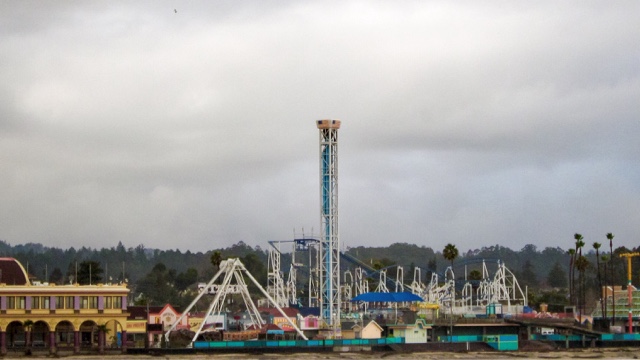
Santa Cruz Boardwalk and Wharf

Originally constructed to help with the shipping of potatoes to San Francisco during the Gold Rush, the Santa Cruz Wharf was opened on December 5th 1914.  As roads improved and vehicles became more capable, the wharf primarily became the hub for the North Monterey Bay Fishing Industry.  By the 1950s, as the fish population in the area dwindled, families became more able to travel and were looking for recreation.  As a direct result of both of these factors, the Santa Cruz Wharf became a recreational destination. 

The opening of a public bath by John Leibrandt at the mouth of the San Lorenzo River resulted in other baths being opened and becoming a popular tourist destination in the area.  Many people journeyed to enjoy the natural, and what was also touted as medicinal, aspects of bathing in salt water.  The popularity of the public bathhouses resulted in other concessions including restaurants, photo stands and curio shops opening.  

Towards the end of the century Fred W Swanton, a famed entrepreneur and promoter, was commissioned to construct a casino and boardwalk beside the Santa Cruz Wharf.  It was promoted as being the 'Coney Island of the West'.  The first casino was built in 1904 but was destroyed by fire on June 22nd 1906.  Although the building was uninsured, Swanton was able to get investors and hired the well-known architect, Wiliiam H. Weeks, to design the new casino.  The new design included a ballroom, the Plunge, an indoor pool, a pleasure pier and a boardwalk.  Exactly a year after the first casino burnt, the new attraction opened on June 22nd 1907.  A huge ball with over 1,200 guests celebrated the opening.  Thousands of people came out to see the thousands of lights illuminated as the attraction was opened.  

In 1908 the first ride was opened.  It was the L.A Thompson Scenic Railway.  In 1911 famed Danish-born American, Charles ID Looff, delivered a new carousel to the boardwalk.  Looff hand carved his carousels, and he was responsible for building the first carousels at Coney Island as well as many other famed carousels and rides at various amusement parks.  The new carousel was fitted with a 342-pipe, 1894 Ruth Und Sohn band organ.  The carousel is still fully functioning on the Santa Cruz Boardwalk. 

Looff's son, Arthur, suggested that the Scenic Railway on the boardwalk be replaced by a more modern rollercoaster.  In 1924 The Giant Dipper opened.  The ride is still very popular on the boardwalk. 

During prohibition in the 1930s, the casino changed its name to Cocoanut Grove, a play on the name of a popular 1929 Marx Bros movie "The Cocoanuts".  The Cocoanut Grove became a popular spot for famous performers of the time, including Benny Goodman and Artie Shaw. 

In the 1950s several rides, including the Wild Mouse and Autorama, were added to the boardwalk, and more renovations were carried out on The Cocoanut Grove.  The Plunge indoor pool was replaced by a miniature golf course.  An overhead ride giving views of the beach below, called the Sky Glider, was added in 1967.  During the 1970s rides were renovated, and the Wild Mouse was replaced by a water ride called Logger's Revenge.  

In the 1980s The Cocoanut Grove was thoroughly renovated, adding conference rooms and banquet areas.  The Sun Room was built, providing a 6000-square-foot banquet room with a retractable glass roof that allows open-air dining and dancing.  More shops and restaurants were opened on the boardwalk.  In 1988, free summer concerts were held at the beach bandstand, a tradition that continues now.  

In 1989, on October 17th, an earthquake damaged the building that once housed the Plunge, and so resulted in the construction of an adventure centre in its place, known now as Neptune's Kingdom.  During the 1990s many rides were added, including Laser Tag in 1995.   

The boardwalk now has 35 rides and attractions.  The adjacent Santa Cruz Wharf offers restaurants and fishing, as well as gift shops.  Just a short walk from the boardwalk is a world-class surf spot.

The original Plunge pool building, which now houses Neptune's Kingdom, is said to be haunted by two boys that apparently drowned in the pool.  Staff at the boardwalk have reported "strange feelings" and the awareness of a "presence" in The Cocoanut Grove.  An apparition known as "The Lady of the Sea" is said to haunt the Santa Cruz beaches.  She is rumoured to have some involvement in the near drowning of several night surfers.  She is said to be pale and dressed in black clothing, and is most often seen at dusk.  It's been suggested that she drowned in a shipwreck, though no-one is sure which one.

There is also this strange video that shows someone standing on The Big Dipper as the ride is in progress.  Some people say it's a ghost; some say it's a workman, which seems really dangerous as the ride is running.  It's worth a look. 

I stayed in Santa Cruz during very stormy weather, and it's a most beautiful place to spend some time.