Monday, May 22, 2017

Catalina Casino


Catalina Casino is located on Santa Catalina, one of California's Channel Islands.  Santa Catalina is 22 miles (35km) long and 8 miles (13km) wide.  The island was originally inhabited by Native Americans, it was claimed by the Spanish, Mexico and then the United States.  The island was used by smugglers, gold prospectors and for otter hunting. 

In 1919, William Wrigley Jnr purchased controlling stakes in Catalina.  Wrigley Jnr was a chewing gum and confectionery magnate and one of the owners of the Chicago Cubs.  Wrigley Fields, the Chicago Cubs ballpark was named in honour of him. Wrigley Jnr decided to build a dance hall in 1919 on a site known as Sugarloaf Point in Catalina.  Originally cleared as a site to build a hotel, the actual hotel, St Catherine's, was eventually built in Descanso Canyon instead, leaving Sugarloaf Point empty.  Wrigley Jnr constructed the Sugarloaf Casino on the land which served as a ballroom and as the first high school for Avalon.  With a growing population Wrigley Jnr decided to build a larger casino and so razed the Sugarloaf Casino.  Using the word "Casino" for its actual Italian meaning "gathering place" no gambling ever occurred in either Casino on the site.

First Wrigley Jnr expanded the building site, blasting the rest of Sugarloaf Point.  The larger site meant that the new building would have an enhanced view of the sea. Wrigley Jnr employed Sumner Spaulding, an American architect and city planner, along with Walter Weber to design the new building.  Under the supervision of Wrigley Jnr and David M Renton, a Southern Californian builder and business executive, the Catalina Casino was constructed at a cost of two million dollars. 

Catalina Casino was designed in the Art Deco and Mediterranean Revival architectural style.  Art Deco, representing luxury and glamour, was lavish by nature and used many pastiche styles, first appeared in France just before WWI.  It represented a very modern approach to architecture.  The Mediterranean Revival style, also adopted for the Catalina Casino, draws heavily on the architecture of seaside villas and palaces. 

The circular building is 12 storeys high and was built to serve as a movie theatre on the bottom floor and a ballroom and promenade on the top floor.  To reach the top levels there are ramps instead of stairs, something Wrigley Jnr modelled on a baseball stadium and believed to be a more effective way for large groups of people to move swiftly from level to level. The movie theatre was the first of its kind to be designed to play talkies, movies with sound. The theatre can accomodate 1,154 patrons and still has its 4 manual, 16 rank pipe organ, built by the Page Organ Company of Lima, Ohio.  The theatre is expertly soundproofed against the ballroom above it. The Catalina Casino theatre has one large screen. Such movie moguls as Cecil B DeMille, Samuel Goldwyn and Louis B Mayer were said to have sailed over to Catalina in yachts,  just to view their new movies in the luxurious cinema.

The ballroom on the top floor of the casino has a dance floor that can accomodate 3000 people.  It is the largest circular ballroom in the world. An open balcony runs around the building and access to this romance promenade is through French doors in the ballroom. The circular Dome of the ballroom has outstanding acoustics. 

In 1953 Philip K Wrigley (P.K), the son of William Wrigley Jnr established the Catalina Island Museum on the first level of the casino.  Created to preserve the history of the pre-Colombian indigenous Island Tongva to the pre-war twentieth century history of his father's development of the island, the museum was moved to another building in 2016. 

The casino has been used for many purposes over the years and still remains large enough to serve as Catalina's civil defence shelter.  The building holds enough food and water to last two weeks for the entire population of Catalina. The interior walls retain the original murals of Art Deco artist John Gabriel Beckman.  Catalina Casino won awards from the Californian Chapter of the American Institute of Architects for being "one of the outstanding architectural accomplishments".  

There have been frequent rumours of paranormal phenomena in and near the Catalina Casino. The women's restroom on the mezzanine floor of Catalina Casino is said to be a hotspot of unexplained occurrences.  Mysterious sounds, cold spots and a feeling of being watched have all been reported.  A female apparition in period clothing has been spotted walking around the Casino.  One woman had a conversation with a man, believed to be a ghost, who no one else saw as he walked away from her.  A local couple went to the cinema.  The husband left his seat for a moment and his wife felt something brush against her arm and assumed her husband had returned.  No one was beside her when she looked but the seat had an indent like someone was sitting next to  her.  A tour guide setting up a slide show was confused when music started playing on its own.  People have reported hearing music and people talking when the Casino is empty.  

I love Catalina with its beautiful architecture and kitschy transport, especially the golf carts you can hire to travel all over the island.  It's said to have a vortex and has a lot of paranormal activity in various places on the island.  Santa Catalina is worth visiting and exploring. 


Tuesday, May 16, 2017

Flynn House

During the nineteenth century the Irish were the largest group of immigrants to arrive in Canada.  The Great Famine of 1845-1851 and in particular Black 47, the worst year of the potato famine in Ireland, saw 38560 Irish refugees arrive in Toronto. At the time the population of Toronto was only 20000.  Although many of the Irish refugees travelled on to America some stayed and became an instrumental source of labour during the economic boom in the 1850s and 60s in Toronto.  

Daniel Flynn, a master shoemaker, and his wife Sidney moved to Canada from Ireland during the Potato Famine. Flynn worked as an itinerant shoemaker and cobbler for almost a decade.  It was common for a shoemaker, or cobbler, who primarily repaired shoes, to visit a home and mend or make new shoes for a family.  

After a decade Flynn purchased two lots of land in what is now North York, Toronto, formerly known as Newtonbrook, from a Joseph Beckett.  The two lots of land were located on what is now Yonge Street and Drury Road in Toronto.  Flynn built a house with a boots and shoe shop attached in 1858.  The Flynn family, now consisting of Flynn, his wife Sidney and their two daughters designed the house in Ontario Classic Style.  The building consisted of four downstairs rooms, all with wooden floors, two bedrooms and a combined living room and kitchen.  The front room was initially used by Flynn as his workshop.  Eventually as his business grew Flynn constructed a seperate boots and shoe store on the land beside the house, the vacated workshop in the house becoming the kitchen.

The Flynn house was relocated to the Black Creek Pioneer Village in 1959. It is a unique building in the village as it directly reflects how a tradesman lived in the nineteenth century in Ontario.  Daniel Flynn's boot and shoe shop was also relocated to the village.  

The Flynn house is said to be haunted by Sidney, Daniel Flynn's wife. She has been seen in the garden of the house in a long yellow dress.  A security guard saw the apparition of Mrs Flynn at 4am one morning  and reached out to touch her believing her to be an intruding in the Pioneer Village and she vanished.  He was so shaken by the experience he quit his job.  Mrs Flynn, in her yellow dress, was also seen by a group of guests at the village. She was said to be walking down the street and then simply vanished. The reconstructed Flynn house has paintings of saints on the walls, as was typical of Irish families of the time.  The pictures of the saints are said to move and sometimes be swapped according to staff at the Pioneer Village. Staff at the village would sometimes cook on the stove in the Flynn house.  One day a kettle was heard boiling and whistling in the house but when staff arrived the kettle and stove were cold.  Cookies and cakes baked in the Flynn house by the staff would be moved or taken. Mrs Flynn sometimes is said to bolt the door when men try to enter the house.  It's not uncommon for staff to find the bed on the right side of the parlour looking as though someone has slept in it. 

Although I didn't get to see inside the Flynn House when I visited the Pioneer Village as it was having work done, I did see it from the outside.  I did see the Flynn Boots and Shoe Store.  It is a wonderful representation of life in the ninteenth century for a couple who had come from a distant shore and made Canada their home. 


Sunday, May 7, 2017

Chateau Marmont Hotel

Built in 1927-1929, the Chateau Marmont is located on Marmont Lane and Sunset Boulevard in Los Angeles.  A prominent Los Angeles lawyer, Fred Horowitz, had chosen the site.  Horowitz had travelled to Europe and been inspired by the Chateau d'Amboise, a Royal Retreat in the Loire Valley in France.  The Chateau d'Amboise had once been home to Mary Queen of Scots, and was believed to be the final resting place of Leonardo da Vinci.  In 1927, using photographs of the Gothic-style Chateau d'Amboise, Horowitz asked his brother-in-law, architect Arnold A Weitzman, about designing the Chateau Marmont.  The Chateau Marmont was designed in Norman Revival style by architect and designer William Douglas Lee.  Responsible for the design of several iconic Los Angeles buildings, Lee was engaged in a lawsuit with Horowitz over fees for the Chateau's design.  Lee won the lawsuit. 

The seven-storey L-shaped building was originally going to be called Chateau Sunset, then Chateau Hollywood, until it was decided it would be called Chateau Marmont in honour of the small street it was partly situated on.  Chateau Marmont opened its doors on February 1st 1929, with over 300 people passing through it at its inaugural reception.  It was a new residence in Hollywood, and the newspapers described the Chateau as the 'newest, finest and most exclusive residence in Los Angeles'. 

During the depression the high rents saw a reduction in the number of residents, and Horowitz sold the property for $750,000 cash to Albert E Smith.  In 1931, Chateau Marmont became a hotel, with the apartments becoming suites.  The entire property was refurbished.   The Chateau Marmont was managed in the 1930s by silent-era film star Ann Little.  In the 1940s, nine Spanish cottages were built next to the hotel as well as four new bungalows, two of which were designed by Craig Ellwood.  A hotel pool was also added.  Ellwood was an influential modernist.  An untrained architect, he was professionally recognised for his fusion of the formalism of Mies van der Rohe's modernism and the less formal Californian style.  During the 1940s, the hotel served as an air raid shelter for the surrounding area. 

By the 24th of March 1976, the Chateau Marmont was officially recognised as one of Los Angeles' Historical-Cultural Landmarks.  The Chateau Marmont was designed to be earthquake-proof, and has survived many large earthquakes over the years.  In 1990, the Chateau Marmont Hotel was acquired by Andre Balazs.  A Bostonian, Balazs owns properties across the United States, including a portfolio of hotels.  Balazs updated the hotel, strictly adhering to its original form.  The entire building was re-carpeted and repainted, and the public areas were upgraded.

The Chateau Marmont Hotel was notorious for its reputation as a place for famous people to misbehave.  This had its beginnings in the 1930s, when the Motion Picture Code and the Purity Seal of 1934 were introduced.  The Code was designed to control what was shown in films, while the Purity Seal dictated the behaviour expected from movie industry workers off-screen.  It's said that the then-head of Columbia Pictures, Harry Cohn, once said to his stars, William Holden and Glenn Ford, "if you must get into trouble, do it at the Chateau Marmont."  The thick walls, the discreet and protective staff, and the private entries, all made the Chateau Marmont a popular destination for those wanting to engage in behaviour that may not be deemed 'appropriate'. 

Clark Gable and Jean Harlow were said to have had a tryst in the hotel while she was on her honeymoon there.  Harlow reportedly would hang a sign on her door saying 'gone fishing', meaning she was out on Sunset Strip looking for a handsome young model to seduce.  Nicholas Ray was rumoured to have been having an affair with underage actress Natalie Wood.  James Dean famously jumped through Nicholas Ray's bungalow window in an attempt to get a part in the movie Rebel Without A Cause.  Another member of the Rebel Without A Cause cast, Dennis Hopper, hung around the Chateau and eagerly filmed orgies which sometimes involved up to fifty girls.

Howard Hughes spent months in the Chateau Marmont, and it was reported that he would spy on the girls in the pool from his room.  Elizabeth Taylor, after saving Montgomery Clift's life following an automobile accident, nursed him back to health at the Chateau Marmont.  Sharon Tate and Roman Polanski lived in the Chateau in 1968.  Jim Morrison lived at the Chateau in 1970, and much of the Oliver Stone film The Doors was filmed there.  Morrison apparently fell from the drain pipe of the hotel, injuring himself.  In the 1960s, the drummer from Led Zeppelin drove his motorbike through the foyer of the hotel. 

On March 5th 1982, actor and comedian John Belushi was found dead in Bungalow 3.  Belushi had been partying with friends Robert de Niro and Robin Williams, among others.  He returned to his bungalow and, with the assistance of his girlfriend, took a mixture of cocaine and heroin.  The drug cocktail proved to be lethal to the 33-year-old.

On January 23rd 2004, photographer and resident of Chateau Marmont, Helmut Newton, died when he crashed his car into the driveway wall.  Both Lindsay Lohan and Britney Spears have been evicted from the Chateau, Lohan for unpaid bills and Spears for smearing food on her face in front of other guests.  Rocker Billy Idol reportedly trashed a room when truffle oil was put on his chips and not beside them.  

Many famous people lived and created work at, or about, the Chateau Marmont.  Billy Wilder, who said of the Chateau that he would live in a bathroom there rather than in any other hotel, apparently did exactly that on occasion.  The aspiring director lived in the bathroom when his roommate, Peter Lorre, actor and drug addict, became too over-zealous.  Dorothy Parker lived at the Chateau with a man twenty years her junior.  Jay McInerney wrote his screenplay for Bright Lights, Big City, there.  F. Scott Fitzgerald also stayed at the Chateau, and there are conflicting reports as to whether he had a heart attack in the hotel or across the street at a cigarette store.  Hunter S Thompson, Annie Leibovitz and Tim Burton have all stayed at the Chateau Marmont. Heath Ledger was filmed snorting cocaine in the hotel foyer.  Charles Bukowski mentions the Chateau Marmont in his work 'Hollywood', and the Grateful Dead song 'West LA Fadeaway' is set in the iconic hotel.  Some people believe that the Chateau Marmont was the inspiration for the Eagles song 'Hotel California'.

With its colourful history, it's no surprise that the Chateau Marmont has many reports of paranormal phenomena.  In 1999, a family moved into Bungalow 3 whilst their home was undergoing renovations.  During their stay at the Chateau Marmont, their two-year-old boy started laughing and giggling at what seemed to be nothing.  When asked what was making him laugh, he simply said that the funny man was.  One day, the child's mother was reading a book about the Chateau Marmont and came to a picture of John Belushi, at which point her two-year-old pointed and said "the funny man".  John Belushi isn't the only famous person said to haunt the Chateau.  Boris Karloff, who lived with his wife in the Chateau for seven years, Howard Hughes, Marilyn Monroe and Jim Morrison are all said to haunt the hotel.  An author researching a book he was writing about the Doors decided to stay in the same place as Jim Morrison.  He was awoken one night by the sounds of a party.  Still sleepy, he went to the window to see where the noise was coming from, only to realise it was actually coming from the room he was in.

Room 79 in the Chateau Marmont is also said to be a highly active room for paranormal phenomena.  There have been ghostly sightings in the room, furniture moving, and even a floating head outside the window.  A woman staying at the Chateau Marmont also reported that, while she was laying in bed, she heard the window open and then felt someone get into bed with her.  When she looked, no-one was in the bed beside her, but the window was open when it hadn't been before.  

I have spent a lot of time in LA, and I find the Chateau Marmont Hotel such an interesting place, both architecturally and because of its fascinating and very colourful history. 


Tuesday, May 2, 2017

Burwick House

Burwick House was originally built on Pine Street in Burwick which later became Woodbridge in 1844. The house was built by Rowland Burr, who was born in Philadelphia but moved to Canada with his family when he was still a young boy.  Burr was a contractor, Justice of the Peace and landowner.  He is best known for his staunch views against alcohol and his support of building a canal linking Toronto and Georgian Bay via the Humber and Holland Rivers and Lake Simcoe and the Severn and Nottawasaga Rivers.  

Burr bought land on the Humber River, subdividing it and creating the village of Burwick.  It was here that Burr constructed Burwick House.  The house was built with an imposing facade indicative of the rural Georgian style of architecture.  Traditional Georgian architecture was a set of styles current between 1714 and 1830 based on the classical architecture of  Rome and Greece.  The style was revived in the colonies and Burwick House is a good example of the style.  

Burwick House is two storeys and was constructed with mortise and tenon joint framing and covered in clapboard.  Mortise and tenon joinery has been used for thousands of years by woodworkers all around the world to join wood mainly at an angle of 90'.  The interior of the house was finished with lath, compromising of thin strips of wood forming a foundation for the plaster.  Burwick House has a kitchen at the rear and was constructed with an adjoining coach house.  In 1958 Burwick House was one of the first structure relocated to the Black Creek Pioneer Village, a recreation of 19th Century life in rural Canada on Black Creek, a tributary of the Humber River.  The front part of the building was moved first.  The kitchen wing was faithfully reconstructed as authentically as possible.  The barn was acquired and recreated separately.  

Burwick House is a very active building with many seperate accounts of paranormal phenomena being reported by visitors to the Black Creek Pioneer Village and by the staff.  Knocking sounds, cold spots, unexplained footsteps and objects moving of their own volition have all been reported.  A grandfather clock that is situated in the house is believed to be enchanted and chimes unexpectedly even though the clock no longer works.  A staff member responsible for closing the curtains on the top storey of the house often reported coming out of the building and locking it for the night only to find one or all the curtain open again when she reached the street and looked up.  A rocking horse in the house rocks by itself like someone is riding on it.  A full female spirit has been seen standing at the fireplace or by the rocking horse.  

The Black Creek Pioneer Village is a beautiful place to visit and is filled with relocated historical buildings that seem to have bought their former occupants with them. 


Monday, April 24, 2017

The Prince of Wales Niagara-On-The-Lake

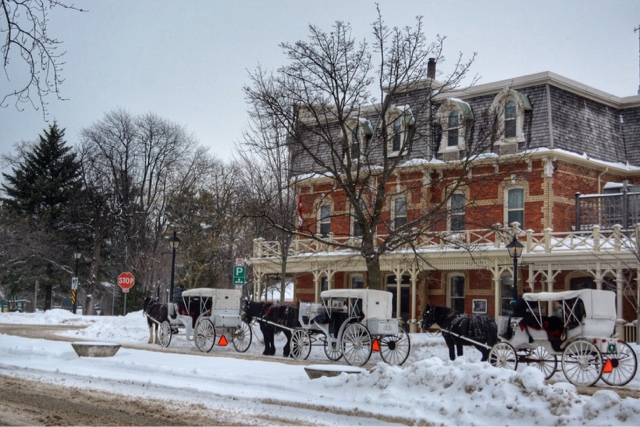
Located on King Street and Picton in the historical precinct of Niagara-on-the-Lake, The Prince of Wales hotel was built in 1864 by William Long.  Niagara-on-the-Lake, once known as Newark was the first capital of Upper Canada and the bustling shipping town had served as the First Seat of Parliament and headquarters of the British Army during the War of 1812.  The 1864 cornerstone of the hotel, still visible today, shows that the building was constructed three years before the Confederacy, the uniting of the British Colonies of Canada, Novia Scotia had New Brunswick to create one Dominion of Canada.  

William Long called his hotel Long's Hotel and it originally catered to all manner of guests.  Long was a hotelier as well as an auctioneer.  He often used the hotel dinner bell to advertise sales during his auctions. The hotel was completely rebuilt in 1888.  Built in red polychrome bricks the building is designed in the Second French Empire style.  Adhering to this architectural style the Prince of Wales has a unique mansard roof, beveled corners and quoins.  In 1890 Long was involved in an accident involving runaway horses.  His recovery was drawn out and the ensuing stress meant the hotel was eventually sold in 1899 to Patrick J. O'Neil.  The hotel was renamed Niagara House.  

The hotel was marketed by O'Neil as an "Uptown Summer Hotel" that was catering to the well-to-do travellers coming to Niagara-on-the-Lake from the United States and Europe.  Among the guests that came to stay at the hotel were the Prince of Wales King George V, son of Queen Victoria, and his wife Mary.  In honour of the visit the hotel name was later changed to The Prince of Wales.  Following O'Neil's death the hotel was sold to the Brownlee family. The hotel lost popularity during the depression.  In 1975 the Weins family purchased the hotel.  They refurbished the hotel, extending it along Picton and King Street.  John Wein added a South Wing, the Court Building and the Studio.  

In 1997 the Prince of Wales was added to the Vintage Hotel properties owned by Jimmy Lai.  The hotel was closed in 1998 for extensive refurbishments. Lai placed his sister, Ms. Si Wai Lai in charge of the renovations.  She went on to hire design architect Victor Tarnay to assist.  On July 1st 1999 the Prince of Wales reopened.  The renovations captured the essence of the hotel's history.  A large stained glass wall, created by Gundar Robe, decorates the foyer.  Ms. Lai also payed homage to her Chinese heritage acquiring an ivory table, dating back to the K'ang-his dynasty of 1662-1722, engraved with a battle scene, that once belonged to the Empress Dowager Tzu Hsi. The Prince of Wales has the largest collection of Victorian style rooms in Canada.  

There are many conflicting accounts of the hauntings in this building.  One account suggests that a wooden house on the land prior to the hotel was the home of a young woman.  During the siege of Niagara-on-the-Lake in the War of 1812, an American soldier was asked to search the supposedly abandoned building.  After searching the first floor and finding it clear the soldier had proceeded upstairs to the second floor.  He saw a figure by the window, rushed towards it and ran his bayonet through what he thought was a British soldier.  He actually murdered Molly McGuire, an innocent woman, who had been looking out at the lake hoping her husband was returning.  The room that sits in the location of the place in which Molly McGuire was murdered is room 207 in the Prince of Wales. Lights have been known to flicker in this room and water faucets turn off and on by themselves.  

Another source confusingly cites the origins of the ghost, whose spectral form has been seen wandering in the foyer, along the halls and in room 207 as actually being a woman from the early 1900s.  The woman supposedly fell in love with a soldier training at Camp Niagara during World War One.  With the soldiers departure date approaching the young couple decided to have the ceremony and honeymoon at the Prince of Wales.  Following the ceremony the soldier was sent to France.  For a year they wrote letters of love and longing before the woman received a cable explaining that her husband had been killed.  The woman refused to believe it was true and locals in Niagara-on-the-Lake got used to seeing the forlorn bride standing at the window of her room in the Prince of Wales looking out at the street.  She became so distraught and convinced her husband had deserted her that she never left the room.  The woman was found deceased in the room clutching a picture of her husband.  In relation to this haunting there have been flickering lights, the sighting of a wispy spectral figure, rapping on doors and an ethereal face staring from the window of room 207 when no one is in the room.  

One of the problems with the paranormal not being taken seriously is the fact that many of the supposed "experts" or "investigators" writing about these reported events do no research and dates are wrong.  Ghosts and hauntings are described with all sorts of errors in the events.  These pieces of information are then shared and a game of Chinese whispers ensues resulting in erroneous details being shared and hence giving skeptics fuel.  

I have been to Niagara-on-the-Lake many times and always stay at the beautiful Prince of Wales.  I enjoy the High Tea served in the Drawing Room and the beautiful suites decorated authentically.  If this lovely hotel is haunted it doesn't ever feel like something bad. I have had a little experience here myself while lounging in one of the beautiful baths in the corner suite.  My radio turned on unassisted.  I just enjoyed the bath and the ethereally chosen music.  


Monday, April 17, 2017

The Temple, London

Just off the Strand in central London, the Temple is an almost hidden district.  With an interesting mix of 17th-, 18th- and 19th-century architecture, the Temple also houses the historic Temple Church.  One of only two round churches in the United Kingdom, the Temple Church is modelled on the Temple in Jerusalem.  Originally known as 'Novum Templum', meaning 'New Temple', in the 12th Century, the Temple Church was built by the Knights Templar, serving as a stronghold for the Knights Templar who were moneylenders, warriors, and mystics.  

The Knights Templar, with their distinctive white mantles emblazoned with a red cross, was a military order that reported to the Catholic Church.  The order was recognised in the papal bull Omne Datum Optimum of the Holy See.  A public decree issued by the Pope, a papal bull is named after the leaden seal, or bulla, that is attached to the bottom of the decree to authenticate it.  The order of the Knights Templar was founded in 1119, and was active from around 1129 to 1312.  Wealthy and powerful, the order became a favourite charity throughout Christendom, adding to its membership and influence.  

With its increasing power, the crown heads of Europe started to perceive the Knights Templar as a threat.  The Knights Templar were associated with the Crusades and, when the Holy Land was lost, trust in the Order diminished.  King Philip IV of France, deeply in debt to the Knights Templar, took advantage of the situation and outlawed the Order, torturing and burning many members at the stake in order to get false confessions.  Under pressure from King Philip IV,  Pope Clement V dissolved the order in 1312.  The Temple was claimed by the Crown following the dissolution of the Knights Templar.  In 1324, the Knights Hospitallers claimed the Temple from their deposed rivals.  Edward II, however, bestowed the Temple on a favourite of his, Hugh Le Despencer, who was later hung, drawn and quartered.  Following Hugh's death, the Inner Temple was given to the Mayor of London and then, in 1333, to William de Langford, the King's Clerk, for a ten-year lease.  

In 1337, the Knights Hospitaller petitioned the King, now Edward III.  In response to this petition, the Inner Temple was divided between consecrated land to the East and unconsecrated land to the West.  The Eastern part was the Inner Temple, and the Western part became the Middle Temple.  Langford kept the Middle Temple, with his lease running out in 1346, while the Knights Hospitaller eventually leased the Inner and Middle Temples to lawyers, continuing a tradition which began in 1320.  Henry VIII dissolved the Knights Hospitaller in the Reformation, but he allowed the barristers to remain as tenants for the Crown.  The Outer Temple was given to the Bishop of Exeter and, eventually, was purchased by Robert Devereaux, an English nobleman and favourite of Elizabeth I.  

The location of the Temple was increased in size when the River Thames was embanked by Victoria Embankment.  After WWII, the Inner and Middle Temples had to be rebuilt.  With an area that is now bound by the River Thames to the south, Surrey Street to the West, The Strand and Fleet Street to the North and Carmelite Street and Whitefriars to the East, the Temple is the main legal district of London.

The Temple includes the Inner Temple which is one of the four Inns of Court.  All practitioners of law in England and Wales must belong to one of the four Inns of Court.  The Inns of Court originated as hostels and schools for student lawyers in the thirteenth century.  Each Inn has its own gardens, dining halls, libraries and administration buildings.  The Inner Temple was one of the two halls constructed by the Knights Templar, and still retains the buttery from its medieval heritage.  The Inner Temple serves as a professional association for Judges and Barristers.  The Middle Temple, also a remnant of the Knights Templar (though none of the original build remains), houses the Honorable Society of the Middle Temple.  New Court was built in 1676 by Nicholas Barbon.  The L-shaped Fountain Court was created in 1680, with the fountain being renovated in 1919.  Fountain Court served as inspiration for authors such as Charles Dickens.  The Temple Church is located between Fleet Street and the River Thames, and the Temple Bar was the principal ceremonial entrance to the City of London on its Western side from the City of Westminster.  At one time, part of the Temple housed The Devil's Tavern.  This establishment hosted the likes of Ben Johnson, English playwright, critic and poet, who hosted gatherings of the 'Tribe of Ben' in the Apollo Room.  William Shakespeare, Jonathan Swift, Alexander Pope, Dr Samuel Johnson, and Samuel Pepys were also known to frequent the Devil's Tavern.  The Tavern was demolished in 1787. 

From early on, there have been whispers of satanism and black magic performed in the Temple.  Many strange events and vicious murders have occurred within the precinct.  When electricity was installed in the Middle Temple, a skeleton in a box was discovered.  The perfectly-preserved skeleton was believed to be over 200 years old.

When a Miss Broderick took up residence in the Middle Temple at Brick Court, she is said to have arranged to meet her lover, a Mr Eddington.  When he arrived late without a satisfactory reason, she shot him dead.  

Sarah Malcolm, an educated, middle-class young woman, was hanged at twenty-two years of age for a triple murder in Tanfield Court in the Temple.  She was employed as a launderess for several chamber apartments in the Inns of Court.  One of her customers was a frail elderly woman called Lydia Duncomb.  Mrs Duncomb lived in an apartment in Tanfield Court where she was assisted by two live-in servants, sixty-year-old Elizabeth Harrison and seventeen-year-old Anne Price.  It's said that Anne Price had her throat cut, Elizabeth Harrison was strangled, and Lydia Duncomb was strangled or had died of fright.   Although Sarah Malcolm claimed she was part of a group robbing the home, she was the only one charged and executed for the crime. 

The Temple is famously haunted by Judge Henry Hawkins.  His full-bodied spirit has been seen with judicial wig and papers under his arms walking through the Temple precinct, even in daylight.  He is said to appear most often when only one person is present to see his spirit.  Henry Hawkins, 1st Baron Brampton, was an English Judge who served in high-profile cases as Judge of the High Court of Justice between 1876 and 1898. 

I love London, and the Temple is such a fascinating place to visit. 


Monday, March 13, 2017

Half Way House Inn

The Half Way House Inn is a Georgian, two storey building that was constructed between 1847 and 1849 by Alexander Thompson and his wife Mary McClure.  The Inn was built on land that had originally belonged to Mary's great grandmother Sarah Ashbridge. The Ashbridge family were Quakers from Chester County in Pennsylvania.  Following the American Revolutionary War they left America and as United Empire Loyalists they were granted 600 acres (240 ha ) of land on Lake Ontario east of the Don River.  Sarah Ashbridge arrived in Canada with her two sons, three of her daughters and their families, following the death of her husband, Jonathan, in 1782. 

After their marriage, Alexander Thompson and his wife built the Half Way House Inn between four farms owned by Mary's siblings and one that belonged to her uncle.  The actual building was situated on a piece of land from William Hale's farm and a sliver of a farm belonging to Isaac Ashbridge.  It was constructed to serve as a resting place that would accomodate passengers travelling by stage coach between Dunbarton, Pickering and Toronto. Many of the travellers were taking their produce and goods to the St Lawrence Markets in Toronto.  Prior to the unification of the British Colonies of Canada, Nova Scotia and New Brunswick, these pre-confederation resting stops for travellers were popular places for liquor and entertainment.  They were cheaper to visit then the finer town hotels built after the mid century.  The Half Way House Inn offered relaxation and kegs of Mr O'Keefe's Brew or Gooderham's Whiskey.  

By 1865 a small village had risen around the Half Way House Inn.  The village, called Mortlake, had a post office that was located in the Half Way House Inn.  Following Alexander's death in 1867 Mary continued to get the tavern licence until the building was sold to Ignatius Galloway.  The new owner added a dining room and a kitchen to the building.  Galloway remodelled the second floor, using the Inn Keepers quarters and meeting rooms to create a ballroom.  As time passed the rooms in the building were used as classrooms, a church and for community meetings.  Eventually the main floor was leased out for retail purposes.  The Bluff Smoke Shop and the Midland Bargain Centre were long time tenants in the 1950s.  Albert Christensen TV, Radio and Appliance Repairs and a paint store also had tenancy within the building.  

In 1962 it was decided that the building would be carefully dismantled and reconstructed in Black Creek Pioneer Village.  The building was renovated, with the kitchen of the house being faithfully returned to its former glory using archival documents.  A more modern restaurant facility was added to the building.  

The Half Way House Inn is said to be haunted by a lady in blue.  The apparition has been sighted in the ballroom, on the balcony and standing on the stairs.  Knocking has been heard on the restaurant walls and the radio inexplicably turns off and on.  A wardrobe in the hallway has the door opened from time to time.  Some people believe that the woman in blue is Mary McClure, Thomas Alexander's wife.  There are those that feel she haunts the building because she was angered by the fact that Thomas had been married to a relative of hers, who had died young, prior to their marriage. This however seems strange as its believed Mary was well aware of Thomas' first marriage.  Perhaps she just loved the Inn and has decided to stay. 

I enjoyed visiting the Black Creek Pioneer Village and it's quite amazing to visit the Half Way House Inn and walk through it imagining the many people who must have at one time or another enjoyed its hospitality.